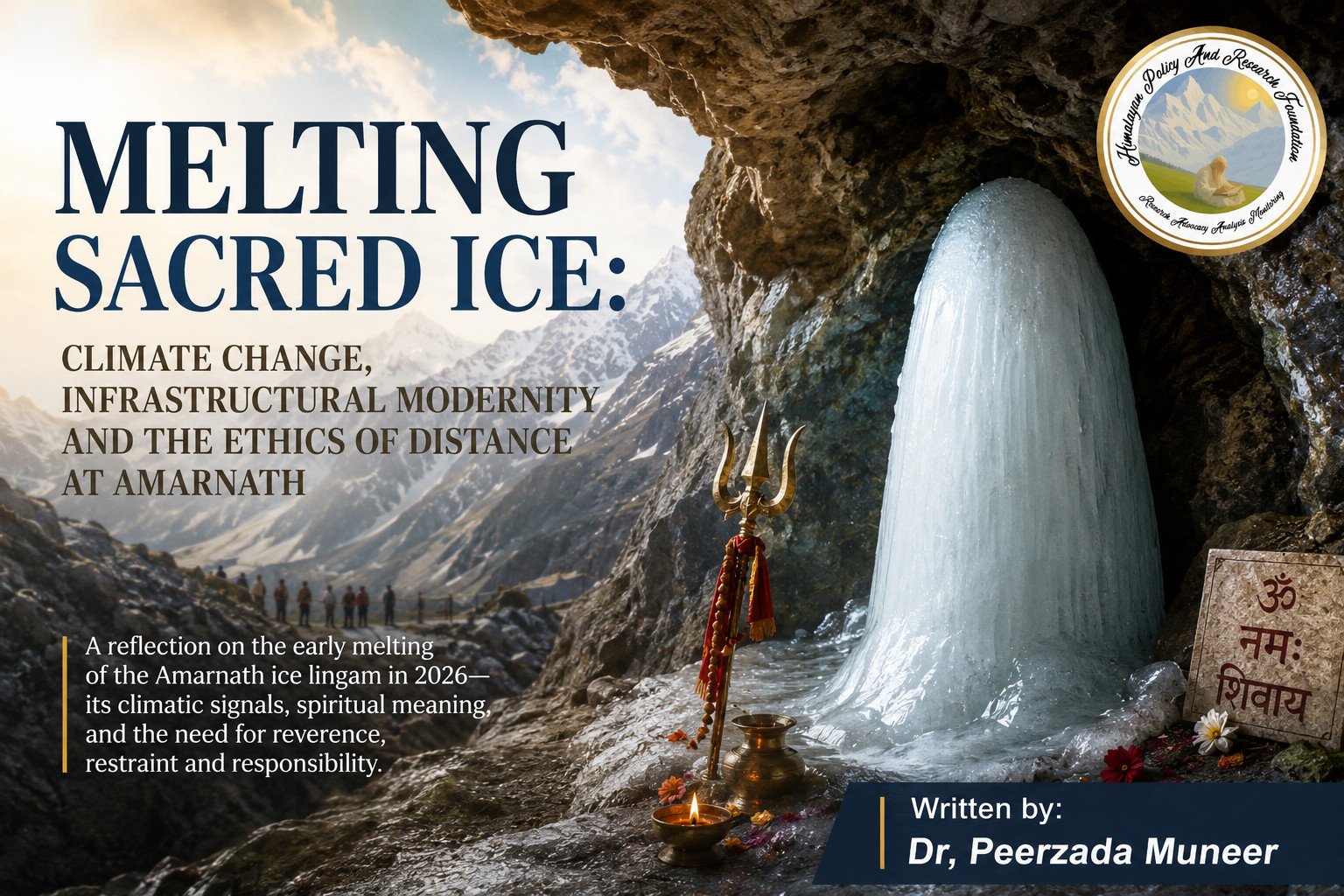
Written by: Dr. Peerzada Muneer
Cryospheric Change and Sacred Materiality
The reported early melting of the naturally formed ice lingam during the 2026 Amarnath Yatra should be understood neither as an isolated curiosity nor as evidence for an unqualified causal claim. The pilgrimage began on 3 July and is scheduled to conclude on 28 August, yet reports published during its opening days stated that more than 90 per cent of the formation had already melted. That figure remains a media-reported estimate rather than a calibrated scientific measurement. The subsequent demand by the Shri Amarnath Barfani Langars Organisation for an independent investigation is therefore significant: it acknowledges that the phenomenon requires analysis of regional climate, cave microclimate, hydrology, airflow, visitor density, lighting, equipment and nearby construction before responsibility can be apportioned (Shri Amarnathji Shrine Board; NDTV; The New Indian Express). The most defensible interpretation is that the episode constitutes a compound socio-ecological event operating at three scales: long-term anthropogenic warming provides the background forcing; seasonal temperature and precipitation variability shape the immediate conditions; and site-specific human interventions may modify the cave and its surroundings. Evidence is strong for the first scale, suggestive but incomplete for the second, and presently insufficient for quantifying the third.
The regional climatic context is nevertheless difficult to ignore. A 2026 study based on observations and reanalysis data for 1980–2024 found spatially heterogeneous but clear warming across Jammu and Kashmir, including increases of nearly 1°C over the last two decades at high-altitude locations such as Pahalgam and Gulmarg. It also identified elevation-dependent warming, with particularly strong changes in certain high-elevation and pre-monsoon temperature indicators, and warned of consequences for high-altitude hydrology and cryospheric stability (Gopikrishnan, Kuttippurath and Chandran, 2026) (Scientific Reports). At the larger regional scale, the Intergovernmental Panel on Climate Change concludes that snow cover in High Mountain Asia has declined since the early twenty-first century and that glaciers have thinned, retreated and lost mass since the 1970s, while freezing levels and snowlines are projected to rise further. ICIMOD’s HI-WISE assessment similarly found that Hindu Kush Himalayan glaciers lost ice 65 per cent faster during 2011–2020 than in the preceding decade (IPCC; ICIMOD). The Amarnath ice lingam is a seasonal cave-ice formation, not a glacier, and glacier trends cannot be transferred mechanically to it. They do, however, establish a warming cryospheric environment in which the persistence of natural ice has become increasingly precarious.
The religious significance of this precarity lies in the material constitution of Hindu sacred geography. Diana Eck’s account of the tīrtha defines pilgrimage places as “crossings” in which rivers, mountains, caves, rocks and forested landscapes mediate passage between ordinary and transcendent orders; place is therefore not a neutral container for worship but an active component of religious meaning (Eck, 1981) (Harvard University). At Amarnath, Shiva is encountered through a specific conjunction of altitude, darkness, water, stone, cold and seasonal freezing. In phenomenological terms, the lingam operates as a cryospheric hierophany: sacred presence is disclosed through a vulnerable natural process rather than imposed upon an inert setting. Its early disappearance consequently alters more than a visible object. It disrupts the temporal expectation of darshan, unsettles the relationship between the ritual calendar and the mountain’s seasonal rhythms, and reveals how religious practice depends upon climatic conditions that modern developmental discourse often treats as external to religion.
Climate change, in this sense, affects religiosity materially, temporally, affectively and institutionally. It alters the material form through which the sacred is encountered, the season within which ritual is performed, the emotions through which environmental loss is interpreted and the institutions responsible for managing pilgrimage. Allison and colleagues’ comparative study of mountain religions argues that disappearing ice and transforming landscapes can disturb cosmological orientation and compel communities to reinterpret spiritual practice (Nature Climate Change).
The high-Andean pilgrimage of Quyllurit’i in Peru offers an instructive comparison. There, glacial retreat has led pilgrim authorities to prohibit the former practice of carrying large blocks of sacred ice from the glacier; devotees increasingly carry snowmelt water instead. The comparison is not exact—Amarnath centres on the visual and devotional presence of a seasonal ice formation rather than the extraction of glacial ice—but it demonstrates that ritual adaptation can represent fidelity rather than abandonment. Religious traditions do not preserve themselves by mechanically repeating practices after their ecological foundations have changed; they endure by identifying the ethical purpose of ritual and adapting its performance to protect the sacred medium on which it depends (Nature Climate Change).
At Amarnath, adaptation should therefore not consist of artificial refrigeration, fabricated ice or the engineering of a permanent spectacle. Such measures would preserve the appearance of the lingam while severing it from the natural processes that give it theological force. A manufactured formation might satisfy visual expectation, but it would transform a naturally occurring manifestation into an administered exhibit. A more coherent religious response would protect the climatic and ecological conditions of formation, accept natural seasonal variability and reorganise pilgrimage around ecological limits rather than promise the uninterrupted availability of darshan. The sacredness of Baba Barfani lies partly in the fact that the formation appears and disappears according to processes that remain beyond complete human control. Its impermanence is not a technical defect to be corrected but a theological reminder of human finitude.
Infrastructural Modernity and the Ethics of Distance
The central policy error is to treat Amarnath’s remoteness as a merely technical deficiency. In pilgrimage traditions, distance frequently performs a ritual function. Turner and Turner’s account of pilgrimage as a liminal passage explains how separation from ordinary routines, bodily exertion and temporary vulnerability can weaken established social distinctions and generate communitas—a form of fellowship produced through shared passage and hardship (Turner and Turner, 1978) (Internet Archive). At Amarnath, the arduous route is not simply the cost of reaching the shrine; it is part of the transformation through which the pilgrim approaches it. Sacred distance may therefore be described as a ritual technology: it slows movement, disciplines desire, limits casual consumption and preserves a threshold between the ordinary world and a landscape understood as divine. Eliminating every difficulty can unintentionally eliminate part of the pilgrimage itself.
Research on the “spiritual sustainability” of sacred sites supports this distinction. Aulet and Duda’s comparative study found that limited accessibility can, under certain management conditions, help preserve a site’s spiritual character, while excessive adaptation to tourism can transform sacred space into a consumable attraction (MDPI). Their European cases cannot be transferred uncritically to Kashmir, but the conceptual insight is relevant: accessibility is not an unqualified good; its value depends upon whether it sustains worship or subordinates worship to visitor throughput. Shinde and Olsen similarly argue that sustainability in pilgrimage centres should be assessed by the capacity of a place to retain sacredness and enable continuing ritual participation, not only by visitor numbers, revenue or infrastructure provision (MDPI). The proper question is therefore not how many people can be moved to the cave as rapidly as possible, but how much access the sacred ecology can absorb without losing the very qualities for which access is sought.
“Infrastructural modernity” at Amarnath should be understood as more than conventional industrialisation or the presence of factories. It denotes a governing logic of speed, scale, mechanisation and standardisation expressed through widened tracks, roads, tunnels, heavy machinery, permanent installations, energy systems, expanding camps and waste-intensive service networks. Official documentation records the widening and upgrading of the pilgrimage tracks by the Border Roads Organisation, while NHIDCL tendered a feasibility study and detailed project report for a proposed 10.8-kilometre twin-tube tunnel under Ganesh Top between Chandanwari and the vicinity of Sangam Top (Press Information Bureau; NHIDCL). These measures cannot, on present evidence, be said to have caused the 2026 melting. Their importance lies elsewhere: they indicate a development paradigm that seeks continuously to compress sacred distance and enlarge visitor capacity without first establishing the cumulative ecological and religious consequences.
Comparative evidence from the Central Himalaya demonstrates why such consequences cannot be presumed negligible. Remote-sensing research found substantial forest-cover loss and fragmentation along road corridors, with the greatest changes associated with highway expansion and metalled roads, which facilitate continuous traffic and secondary disturbance. The study recorded a decline in high-density forest cover and found that forest fragmentation increased substantially along highway and road transects (Mann, Agrawal and Joshi, 2019) (ScienceDirect). A separate study of the Rishikesh–Joshimath pilgrimage corridor documented more than 300 road-blocking landslides along approximately 250 kilometres and identified road widening, alongside slope, rainfall and lithology, as a principal control on landslide occurrence (Mey et al., 2024) (Natural Hazards and Earth System Sciences).
These Uttarakhand findings do not establish identical effects at Amarnath, whose geology, vegetation and hydrology require site-specific research. They do, however, invalidate the assumption that roads through young Himalayan terrain are environmentally neutral strips. Roads alter drainage, excavate and load slopes, fragment forest habitats, produce edge effects, intensify traffic and enable secondary construction. Their impact is therefore corridor-wide and cumulative rather than confined to the width of the carriageway. Moreover, accessibility generates its own demand: once a route is widened, arguments emerge for larger camps, parking facilities, electricity networks, sanitation infrastructure and commercial services. What begins as safety-oriented improvement can consequently evolve into an open-ended cycle of capacity expansion.
Defending sacred distance does not require indifference to disability, age, safety or local livelihoods. A just policy should distinguish essential accessibility from mass motorisation. Emergency and medical access, low-impact assistance for older persons and persons with disabilities, carefully regulated pony and palki services, secure tracks, sanitation and weather-warning systems are compatible with the shrine’s integrity. Unlimited vehicular penetration, permanent commercial construction and infrastructure designed primarily to maximise footfall are not. This principle of differentiated accessibility avoids two errors at once: romanticising hardship for people who genuinely require assistance and converting inclusion into a justification for unrestricted development. It also protects local porters, pony operators, tent providers and service communities by placing them within a conservation-based pilgrimage economy rather than displacing them through mechanised transport.
Governance should accordingly move from static crowd management to adaptive socio-ecological carrying capacity. An independent observatory should continuously record cave temperature, relative humidity, carbon dioxide, airflow, drip-water volume and temperature, external snow conditions, visitor density, lighting and equipment heat, with the resulting data placed in the public domain. The upper pilgrimage corridor should be treated as a sacred ecological buffer in which ordinary motor traffic, non-essential permanent structures, high-intensity lighting, amplified sound and waste-generating commerce are prohibited. Every proposed road, tunnel, ropeway or major facility should undergo cumulative landscape-level assessment rather than isolated project appraisal. Daily permits should vary according to trail stability, weather, waste-removal capacity and cave conditions; all materials transported upward should be subject to a return-and-audit system; disturbed slopes and forest edges should be restored with native vegetation; and local communities, scientists and religious representatives should participate in environmental decision-making. Such measures accord with the IUCN approach to sacred natural sites, which treats cultural-spiritual values and ecological integrity as mutually constitutive rather than competing management objectives (IUCN).
The precautionary principle is especially important because scientific uncertainty is frequently misused as permission for further intervention. The absence of conclusive proof that visitor heat, machinery, lighting or altered airflow caused the 2026 melt is not proof that these factors are harmless; it is a reason to measure them before expanding their scale. Equally, the existence of global climate change cannot become an alibi that absolves local governance, because regional warming and local disturbance may interact. Climate change reduces the resilience of the cryospheric system, while construction, congestion and altered land use may introduce additional stressors into an already vulnerable environment.
The early melting of Baba Barfani should therefore be understood as a warning about both atmospheric change and the ideology of limitless access. Amarnath’s aloofness is not a remnant of underdevelopment awaiting correction. It is simultaneously a theological condition, a ritual discipline and an ecological safeguard. A sacred landscape cannot be protected by transforming it into a rapidly accessible spectacle, because the process of maximising access may destroy the material and spiritual qualities that make the journey meaningful. Preserving Amarnath may require the most difficult form of devotion in a consumer age: accepting slower travel, fewer interventions and limits on human presence so that the sacred place is not destroyed by the very desire to reach it.
About the Author