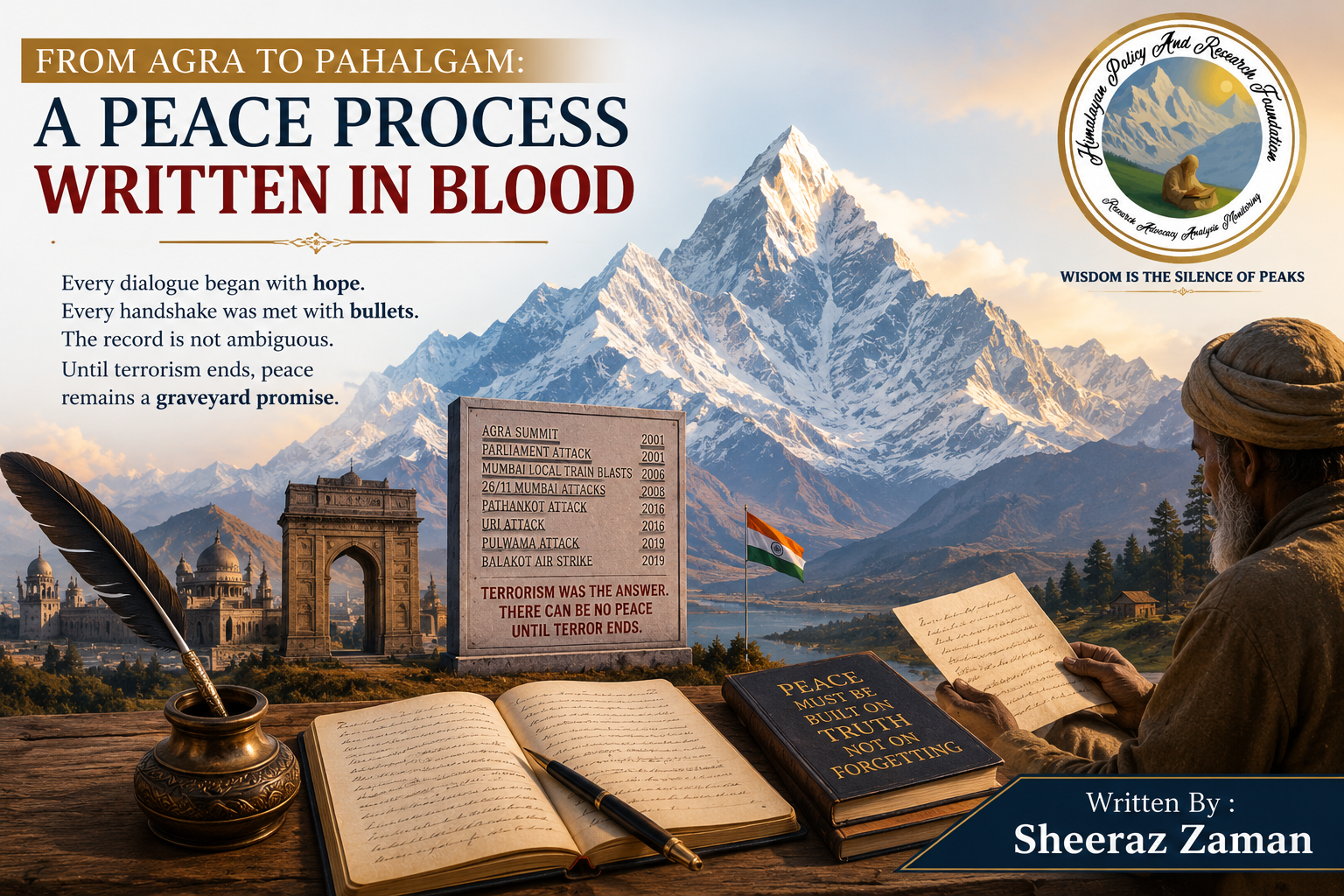
From Agra to Pahalgam: A Peace Process Written in Blood
Written by : Sheeraz Zaman ( Socio political Activist )
An open letter signed by more than a hundred prominent Indians and Pakistanis is doing the rounds again, and it asks for the usual things: restore diplomatic ties, revive the composite dialogue that died in 2008, reopen the Kartarpur corridor, ease travel and pilgrim access. The names on it are serious – Farooq Abdullah, Mehbooba Mufti, Mirwaiz Umar Farooq, Mani Shankar Aiyar on the Indian side; Khurshid Mahmud Kasuri, Pervez Hoodbhoy on the Pakistani side. What is not serious is what the letter does with terrorism. It mentions it once, tucked into a phrase about “addressing the legitimate security concerns of both countries”, as though the murder of Indian civilians and soldiers by Pakistan-based terror groups were a grievance to be traded off against Pakistan’s own complaints. It is not a grievance. It is the reason every previous dialogue process is dead.
Start with the record, because the record is not ambiguous, and because the entire case for reviving comprehensive dialogue rests on ignoring it. This is the part of the debate that gets least attention in the drawing rooms where these letters are drafted. It is easy, from a seminar room in Delhi or a think tank in Lahore, to talk about the shared future of a fifth of humanity. It is harder to sit with the fact that every single time an Indian government has tried to build that future, the attempt has ended not in a stalemate but in a body count, and that the body count has always, without exception, traced back to organisations headquartered on Pakistani soil.
Every handshake, then a body count
Atal Bihari Vajpayee hosted Pervez Musharraf at Agra in July 2001 to try and settle Kashmir. The summit failed to produce even a joint statement. Within weeks, on October 1, 2001, a Jaish-e-Mohammed suicide squad blew through the gates of the Jammu and Kashmir Assembly in Srinagar. Ten weeks after that, on December 13, 2001, Jaish and Lashkar-e-Taiba gunmen stormed Parliament in New Delhi and brought two nuclear-armed neighbours to the edge of war.
The Manmohan Singh government tried again, and for longer. Between 2004 and 2007, a genuine back-channel process with Musharraf produced a Kashmir framework closer to resolution than anything before or since. Lashkar-e-Taiba answered it twice. On July 11, 2006, seven bombs ripped through Mumbai’s suburban trains at evening rush hour, killing over 180 commuters, in an attack Indian and international investigators traced straight back to Lashkar handlers. Two years later, on November 26, 2008, ten Lashkar gunmen trained and dispatched from Pakistan laid siege to Mumbai for three days, killing 166 people while their handlers issued instructions by phone from Pakistani soil. The lone gunman captured alive, Ajmal Kasab, confessed in an Indian court to exactly how and where he was trained. Pakistan’s own prosecution of the attack’s planners has gone nowhere in the years since. That is not an oversight. It is a choice.
Narendra Modi tried the boldest version of personal diplomacy any Indian Prime Minister has attempted with Pakistan. He stopped in Lahore on Christmas Day 2015, uninvited and unannounced, to wish Nawaz Sharif for his birthday. It was a genuinely disarming gesture. Pakistan-based terrorists disarmed it within days: the Pathankot airbase was stormed on January 2, 2016, by a Jaish squad that triggered a multi-day gun battle. Eight months later, on September 18, 2016, Jaish terrorists hit the army brigade headquarters at Uri and killed nineteen soldiers, the worst single attack on the Army in decades. India replied with surgical strikes across the Line of Control — the first time New Delhi publicly owned a cross-border response.
Then came Pulwama. On February 14, 2019, a Jaish suicide bomber drove an explosives-laden vehicle into a CRPF convoy on the Jammu-Srinagar highway and killed forty personnel, the single deadliest attack on Indian security forces in the Valley’s history. India crossed the Line of Control in the other direction this time, striking a Jaish training camp at Balakot deep inside Pakistan — the first acknowledged Indian air strike inside Pakistani territory since the 1971 war. It was a measure of how completely the old playbook of quiet diplomatic protest had failed that an Indian government felt it had no credible option left but to answer a terror attack with an air force.
It is worth pausing on Balakot for a moment, because it marks the point at which India’s patience with the old model visibly ran out. For nearly two decades after Agra, India’s response to Pakistan-sponsored terrorism had been diplomatic: recalling envoys, suspending talks, filing dossiers of evidence with international bodies that were received politely and acted upon rarely. Pulwama broke that pattern. It signalled that an Indian government was no longer willing to treat cross-border terrorism as a matter for demarches alone. That shift did not happen because India became more hawkish for its own sake. It happened because thirty years of diplomatic patience had produced nothing except a longer list of dead soldiers and civilians.
And then, in April 2025, came Pahalgam — terrorists gunning down tourists in cold blood, an attack with almost no formal bilateral dialogue underway to sabotage, because there was none left standing. India answered with Operation Sindoor. Pahalgam is, in a way, the cleanest data point of all. It proves that Pakistan’s terror machinery does not need a peace process to destroy. It only needs an opening, and it will manufacture one out of nothing.
Read that chronology start to finish and tell me it looks like bad luck. It looks like a policy. Six governments, three prime ministers, one dead ceasefire, and one constant: whenever an Indian leader has taken a real political risk to open a door, Pakistan-based terror groups have walked through it with a gun. Not a rival faction acting against Islamabad’s wishes. Not a rogue cell operating beyond the state’s knowledge. The same handful of organisations, operating out in the open, rebuilding under new names when banned, raising funds through registered charities, and holding public rallies inside Pakistan even after being formally proscribed by the United Nations Security Council. This is not a security failure Pakistan has struggled and failed to fix. It is a capability Pakistan has chosen, again and again, not to dismantle.
Stop pretending this is symmetry
This is where the letter’s language does real damage. Calling terrorism a “legitimate security concern” to be weighed against Pakistan’s own grievances launders a state-backed killing machine into a neutral policy dispute. There is no equivalence here. India has never sponsored, financed, trained or sheltered non-state actors to massacre Pakistani civilians. Pakistan has done exactly that to India for thirty years, through Lashkar-e-Taiba and Jaish-e-Mohammed, organisations that operate inside Pakistan with a level of impunity no state serious about eliminating them would tolerate. Hafiz Saeed, the founder of Lashkar and the architect of 26/11, has spent years cycling in and out of token house arrest rather than facing anything resembling justice proportionate to Mumbai’s dead. The United States Treasury has designated Pakistan-based individuals and fronts as terror financiers more than once. This is not India’s grievance alone. It is a documented, internationally recognised pattern of a state using terrorism as an instrument of policy against its neighbour, and getting away with it because the international system has, for three decades, preferred stability theatre to accountability.
It also needs saying plainly: Pakistan’s civilian government does not run this show. The Army and the ISI do. Shehbaz Sharif may genuinely want peace. He does not control the institution that keeps ending it, and no Pakistani Prime Minister since the 1990s has meaningfully controlled it either. A letter asking Islamabad’s civilian leadership for concessions on terrorism is, in effect, addressed to an office with neither the authority nor, most likely, the appetite to discipline the actual power centre that decides Pakistan’s India policy. Every retired Pakistani diplomat who signs these letters knows this, because many of them served governments that discovered it the hard way — watching a carefully built opening with New Delhi collapse within weeks because the Army calculated, correctly, that it could veto the civilian government’s foreign policy with a single attack and pay no domestic political price for it. Pretending otherwise is not diplomacy. It is cover, and every year it continues is another year Pakistan’s military establishment gets to have it both ways: a civilian face for the world’s cameras, and a terror pipeline for its actual strategy.
Why the Indian position has outlasted every government
India’s stated position — no talks while the terror continues — gets mocked in track-two rooms as an excuse to dodge the harder political conversation on Kashmir. It is worth asking why a position so easily caricatured has survived, essentially untouched, from Vajpayee through Manmohan Singh to Modi, across governments that agreed on almost nothing else in foreign policy. That continuity is not inertia. It is three different prime ministers, from three different political traditions, independently arriving at the same operational conclusion after being burned the same way. When Congress and the BJP agree on one thing about Pakistan policy, the smart move is not to assume both are wrong. It is to ask what they both learned.
None of this means India should refuse contact with Pakistan forever, or that ordinary citizens on both sides do not deserve better than a permanent freeze. Kashmiris in Kupwara, in Gurez, in Pulwama and now in Pahalgam have paid for this conflict in blood while it is conducted in Delhi and Islamabad’s name, and it is entirely fair for Farooq Abdullah or Mehbooba Mufti to want that to end. Trade, family reunification, pilgrim access at Kartarpur — these are not favours to Pakistan, they are overdue relief for people who live the consequences daily, and some of them, like Kartarpur itself, can be delivered without waiting on the larger question at all. There is a difference, though, between narrowly bounded humanitarian gestures that do not touch the terrorism question and a comprehensive dialogue framework that treats terrorism as simply one more line item to be traded off against Pakistan’s demands on Kashmir. The letter under discussion collapses that distinction entirely, and in doing so does a disservice to the very Kashmiris it claims to speak for.
But a comprehensive dialogue architecture that puts trade, water sharing and terrorism on parallel tracks, to be discussed together as though they carry equal urgency, is not a serious peace plan. It is a rerun of Agra, of the composite dialogue, of Lahore-Pathankot, dressed up in the language of a fifth of humanity’s shared future. Every version of that architecture India has tried has been blown up, literally, by the same set of actors, operating from the same territory, with the same impunity.
What a credible letter would say
A serious appeal from civil society would not bury terrorism in a subordinate clause. It would say, without hedging, that Pakistan’s military establishment must dismantle Lashkar-e-Taiba, Jaish-e-Mohammed and their successor fronts, verifiably and for a sustained period, before any talks resume on any issue- water sharing , trade or connectivity. It would name these groups as instruments of Pakistani state policy rather than rogue actors Islamabad cannot control. And it would place the burden of proof exactly where thirty years of bodies say it belongs: on Pakistan, not on India.
That is a demanding ask, deliberately so. Declarations of intent have been made before — at Agra, at Sharm el-Sheikh, in the 2003 ceasefire — and each one evaporated within months. A precondition measured in a year of verified quiet, not a joint statement, asks Pakistan’s state to prove something instead of merely promising it again. It should be no less demanding than that, because everything less demanding has already been tried, and has already failed, four separate times, in four separate decades, under four separate governments in New Delhi.
Until Pakistan’s military establishment demonstrates — not declares, demonstrates — that it has given up terrorism as an instrument of state policy, India owes it nothing at the negotiating table. It does not owe Pakistan trade concessions while Jaish-e-Mohammed rebuilds under a new name. It does not owe Pakistan a revived composite dialogue while Lashkar-e-Taiba’s founder addresses crowds a short drive from Islamabad. And it does not owe Pakistan’s civilian leadership the benefit of the doubt on an institution that leadership itself does not command. What India owes its own citizens — in Pulwama, in Uri, in Pahalgam, in the CRPF convoy that was blown apart on a highway it should have travelled safely — is a government that does not confuse the desire for peace with the willingness to be fooled a fifth time.
The next letter from India’s peace lobby, if it wants to be taken seriously rather than merely signed by serious people, should ask Rawalpindi to prove it can stop the one thing that has ended every conversation before this one. Not promise. Prove — through a year, or two, of verified silence from across the border, not a joint statement issued for the cameras and forgotten within a news cycle. Anything less is not a peace proposal. It is amnesia with a letterhead, and Pahalgam’s dead deserve better than being reduced to a footnote in someone else’s dialogue architecture.
About the Author