From Dry Winters to Broken Blossoms: Kashmir’s Water Crisis, Hailstorms and the Climate Signal in Horticulture
Written By: Sheeraz Zaman ( Social Activist )
A winter without storage
Kashmir’s present water crisis cannot be understood only by looking at whether rain has fallen in recent weeks; it must be understood through the failure of winter storage, the weakening of snowpack, and the increasing conversion of slow, useful snowfall into quick, uneven rainfall. In the winter of December 2025 to February 2026, Jammu and Kashmir recorded only 100.6 mm of precipitation against a normal of 284.9 mm, a deficit of about 65 percent, making it the seventh consecutive deficient winter for the region. (Down To Earth) The deficit was sharper in several Kashmir districts, with Shopian reported at 82 percent below normal, Budgam at 71 percent below normal, and Srinagar at 64 percent below normal during the same winter period. (Down To Earth) By early May 2026, the seasonal rainfall deficit since March 1 still stood at 26 percent across Jammu and Kashmir, and only five of the twenty districts had received normal rainfall. (The Week) Shopian, one of the most important horticultural districts of Kashmir, was reported to be 71 percent deficient in seasonal rainfall from March 1 to May 6, while Kulgam was 53 percent deficient and Anantnag was 46 percent deficient. (The Week)
This shows why frequent showers do not automatically end a water crisis. In mountain hydrology, winter snow is not merely precipitation; it is a natural reservoir that stores water in cold months and releases it gradually during spring and summer. ICIMOD reported that snow cover across the Hindu Kush Himalaya fell 27.8 percent below the long-term average between November 2025 and March 2026, the lowest level in more than two decades and the fourth consecutive year of below-normal snow persistence. (ICIMOD) ICIMOD also warned that reduced snowmelt lowers river runoff and intensifies water scarcity, while consecutive low-snow years prevent groundwater and soil moisture from being replenished properly. (ICIMOD) This is why a landscape may receive rain and still remain water-stressed: rain falling in short, intense spells runs off quickly, while snow releases water slowly and helps sustain springs, streams, rivers, and aquifers. (Down To Earth)
The drying of springs in Kashmir is therefore not an isolated local inconvenience but a symptom of a changing mountain water cycle. The Achabal spring in south Kashmir, historically known for its abundant flow, reportedly ran dry in the winter of 2025 for the first time in recorded history. (Down To Earth) AP also reported that the famous Achabal spring dried amid unusually dry weather, while springs and streams, including tributaries of the Jhelum, faced stress and water shortages. (AP News) Weather officials cited by AP said that Kashmir had faced more than 80 percent rain and snow deficit since the beginning of that year, while daytime temperatures remained 5 to 8 degrees Celsius above normal for more than a month. (AP News) The scientific significance of this is that Kashmir’s water scarcity is not contradicted by recent rainfall; rather, recent rainfall may coexist with scarcity because the region has lost the seasonal snow storage that normally regulates the timing and availability of water. (Down To Earth)
Climate change intensifies this contradiction by warming the lower atmosphere, disturbing winter snowfall, and increasing the likelihood that precipitation arrives as rain rather than snow at lower and mid-altitudes. (Down To Earth) The World Meteorological Organization explains that a warmer atmosphere can hold more moisture and that heavy rainfall events have become more frequent and intense since the 1950s in many regions. (World Meteorological Organization) WMO further notes that extreme daily precipitation events are projected to intensify by about 7 percent for every 1 degree Celsius of global warming. (World Meteorological Organization) This means that climate change can produce both dryness and damaging rain, not as opposites but as connected outcomes of an intensified and destabilized water cycle. (World Meteorological Organization) In Kashmir, the result is a dangerous paradox: winters become too dry and warm to store enough snow, while spring and early summer increasingly bring sharp spells of rain and hail that damage fields without solving the deeper groundwater and spring-recharge deficit. (Down To Earth)
Early bloom, untimely rain and hail
The same warming that weakens snow storage also disturbs the biological calendar of fruit trees. In Kashmir’s apple orchards, winter chill, spring warmth, flowering, pollination, fruit set, and fruit development must occur in a careful sequence. Scientific research on apple production under climate change shows that warmer winters can lead to earlier blossom, while insufficient cold days and later damaging weather events can create compound risks for yield. (Springer Nature Link) Apple trees are particularly vulnerable during blossom because yield depends on climatic conditions during winter and spring, and the tree’s developmental clock is shaped by accumulated temperature history. (Springer Nature Link)
This is precisely the pattern that appeared in Kashmir in early 2026. Reports from the Valley noted that temperatures from mid-February to mid-March rose 6 to 11 degrees Celsius above normal, triggering bud break and flowering nearly a fortnight ahead of schedule in apple orchards. (Kashmir Convener) Such early bloom is risky because a blossom is not yet fruit; it is a fragile reproductive stage that must survive rain, cold spells, poor pollination, and hail before it can become a marketable apple. (Springer Nature Link) When untimely rain, sudden chill, or hail strikes at the flowering or early fruitlet stage, the damage is not cosmetic; it can destroy the very tissue that would have become the fruit. (Down To Earth)
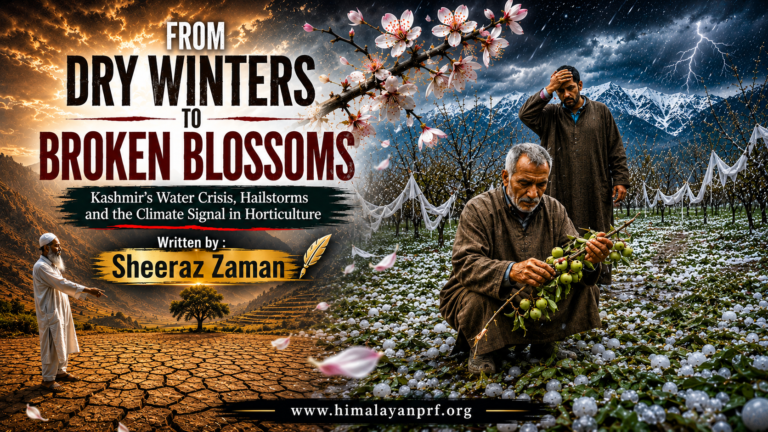
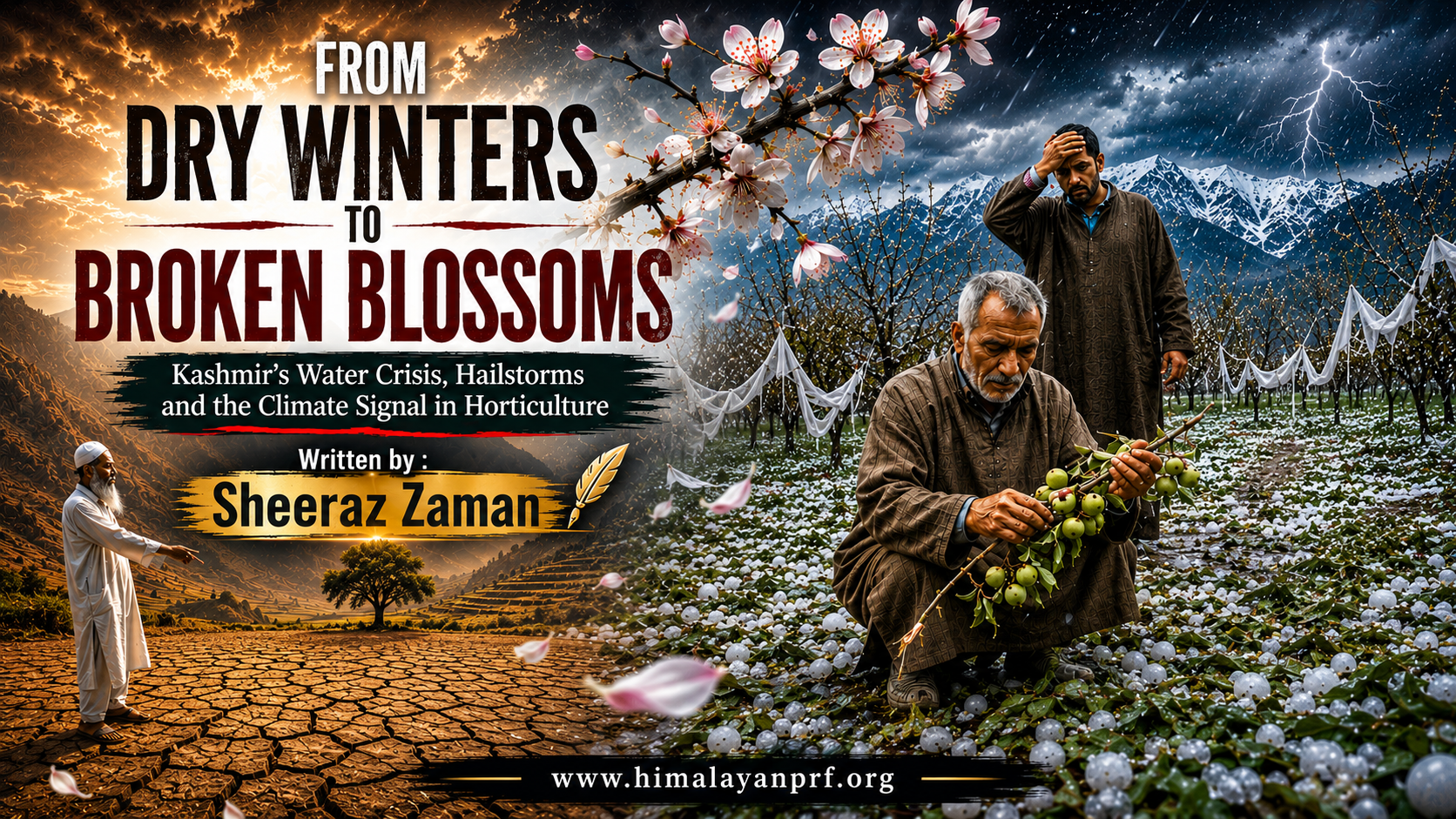
The hailstorms of spring 2026 therefore struck Kashmir at one of the most sensitive points in the horticultural calendar. Down To Earth reported that short but intense hailstorms damaged orchards when they were at the flowering stage, and that hailstones can knock blossoms off trees or injure young fruitlets in ways that cannot be reversed within the same season. (Down To Earth) The same report described severe local damage in orchards, including an example from Damhal village where a grower estimated that 80 to 85 percent of an eight-kanal orchard had been damaged after a half-hour hailstorm. (Down To Earth) It also reported that hailstorms swept through important horticultural belts in Shopian, Kulgam and Bandipora during the flowering stage. (Down To Earth)
By late May 2026, the damage had spread across several parts of Kashmir. The Kashmir News Observer reported that repeated hailstorms had caused nearly 30 percent damage to Kashmir’s agriculture and horticulture sector, according to growers’ representatives. (Kashmir News Observer) The same report cited the Kashmir Fruit Growers and Dealers Association as saying that damage had occurred in areas of Kulgam, Nehama and Shopian in April, followed by affected areas in Baramulla and Bandipora on May 12 and further damage in Rafiabad and Zaingeer areas on May 22. (Kashmir News Observer) The reported damage included places such as Kreeri, Wagora, Kunzer, Andergam, Lolipora, Matrigam, Dardpora, Sumlar, Bohripora, Chitloora, Watergam, Behrampora, Arampora Sopore, Seloo, Warpora, Hadipora and Rohama. (Kashmir News Observer) Public reports also stated that the government had begun field assessments in hail-affected areas for compensation under disaster-relief norms. (Free Press Kashmir)
The scientific link to climate change must be stated carefully. No serious climate scientist would claim that every individual hailstone can be attributed directly and mechanically to climate change, but climate change can alter the background conditions that make severe convective storms more likely or more damaging. A major review in Nature Reviews Earth and Environment explains that climate change affects low-level moisture, convective instability, wind shear and cloud microphysics, all of which are important for hailstorm formation. (Nature) The same review notes that while the regional response of hailstorms is uncertain, hail severity is expected to increase in many regions under climate change. (Nature) In Kashmir, local scientists cited by Down To Earth have connected the recent rise in damaging hail episodes to warmer surface temperatures, greater convective instability, erratic western disturbances and the valley’s topography, where warm air can rise into colder upper layers and support hail formation. (Down To Earth)
This is where the relationship between water scarcity and hail damage becomes intrinsic rather than accidental. The same warming that reduces snow storage can increase atmospheric energy, moisture-holding capacity and instability. (World Meteorological Organization) The same erratic western disturbances that fail to provide steady winter snowfall can later arrive as concentrated spring events, producing intense rainfall and hail instead of slow hydrological recharge. (Down To Earth) The same dry winter that leaves springs weak can be followed by violent weather that damages blossoms but does not restore aquifers. (Down To Earth) Kashmir is therefore facing not only a shortage of water but a disordering of water in time: too little snow in winter, too much intensity in some spring showers, too much hail at the wrong biological moment, and too little dependable recharge for summer. (ICIMOD)
Economic exposure and the need for climate adaptation
The economic consequences of this pattern are serious because horticulture is not a marginal activity in Kashmir; it is one of the central pillars of rural livelihoods. The Jammu and Kashmir Horticulture Planning and Marketing Department states that horticulture contributes about 6 percent to 7 percent of the Union Territory’s gross state domestic product, directly and indirectly employs about 35 lakh people, and supports nearly 7 lakh families. (dhpm.jk.gov.in) The department also reports that the area under major horticulture crops increased from 3.35 lakh hectares in 2020 to 2021 to 3.45 lakh hectares in 2023 to 2024, while production rose from 22.30 lakh metric tonnes to 26.43 lakh metric tonnes. (dhpm.jk.gov.in) Officially reported revenue from fresh fruit was about Rs 5,100 crore in 2023 to 2024, while dry fruit revenue was about Rs 656 crore. (dhpm.jk.gov.in) Other government-linked reporting for 2025 to 2026 placed the annual value of horticulture and floriculture at about Rs 10,000 crore and again described the sector as supporting about 35 lakh livelihoods. (Kashmir News Observer)
Apple is the most important crop within this economy. A government reply reported by Kashmir Life said that Jammu and Kashmir produced more than 21 lakh metric tonnes of apples in 2024 to 2025, with Kashmir division alone producing about 20.79 lakh metric tonnes. (kashmirlife.net) If the growers’ preliminary estimate of nearly 30 percent damage is applied only as a rough exposure indicator to Kashmir’s 20.79 lakh metric tonnes of apple production, it suggests that more than 6 lakh metric tonnes of apple output could be exposed to some degree of loss, grade reduction, or yield uncertainty. (Kashmir News Observer) If the same 30 percent preliminary damage figure is applied to the broader Rs 10,000 crore annual horticulture and floriculture value, the revenue exposure would be roughly Rs 3,000 crore, although this should not be treated as a final official loss figure because damage varies by district, crop stage, orchard condition and later fruit survival. (Kashmir News Observer)
The burden falls hardest on farmers because a hailstorm destroys not only one crop but also a chain of expected payments. Growers’ representatives told KNO that thousands of orchardists and farmers had suffered heavy losses and that many had taken loans for the cultivation season. (Kashmir News Observer) The same report stated that more than 12 lakh people associated with horticulture were suffering because of the hail damage. (Kashmir News Observer) In an orchard economy, the loss of bloom affects labourers, transporters, box suppliers, mandi traders, cold-store operators, commission agents and families dependent on seasonal cash flow. (dhpm.jk.gov.in) Even where fruit survives, hail marks can reduce grade and market price, so the economic loss may appear both as lower yield and lower quality. (Down To Earth)
The policy lesson is that Kashmir can no longer treat drought, hail, early bloom and crop loss as separate problems. Water policy must include snowpack monitoring, spring revival, watershed treatment, local storage, groundwater recharge and efficient irrigation because reduced snow persistence is already weakening the natural reservoir system of the Himalaya. (ICIMOD) Horticulture policy must include climate-resilient advisories, high-resolution hail forecasting, better weather stations, orchard-level risk mapping, anti-hail nets, drainage improvement and crop insurance because extreme spring events are striking during the reproductive stage of fruit crops. (Down To Earth) Down To Earth reported that anti-hail nets are used by only about 0.06 percent of horticulturists, which shows how exposed most orchards remain to a known and recurring hazard. (Down To Earth) The demand for crop insurance made by grower bodies after the 2026 hailstorms is therefore not merely a compensation demand; it is a rational adaptation demand in a climate where risks are becoming less predictable and more concentrated. (Kashmir News Observer)
Kashmir’s crisis is thus not simply that there is less water; it is that water is arriving in the wrong form, at the wrong time, and with destructive force. A dry and warm winter deprived springs, rivers, soils and orchards of their normal cold-season reserve. Early warmth pushed buds and blossoms ahead of schedule, making them vulnerable when rain, chill and hail returned. The hailstorms then damaged the very bloom that was supposed to become fruit, turning a hydrological crisis into an agrarian and economic crisis. Climate change is visible here not as a single dramatic event but as a chain of connected disruptions: reduced snowpack, stressed springs, erratic rainfall, early bloom, convective hail, damaged fruit set, uncertain income and deeper vulnerability among farmers. The future of Kashmir’s horticulture will depend on whether climate adaptation is treated as an emergency response after every hailstorm or as a long-term transformation of water management, orchard protection and rural economic security.
The Himalaya has not yet surrendered; its glaciers, forests, springs, and soils still retain a measure of resilience, but they now ask whether we will answer with restraint or continue in neglect. Let every household, school, orchard, market, office, and institution treat waste management, water conservation, pollution control, and responsible consumption as a moral duty rooted in the Himalayan ethos of balance, humility, and reverence for nature. If we act with discipline today, our small efforts can still gather into a collective shield against a disaster that is no longer distant, but still, perhaps, preventable.
About the Author