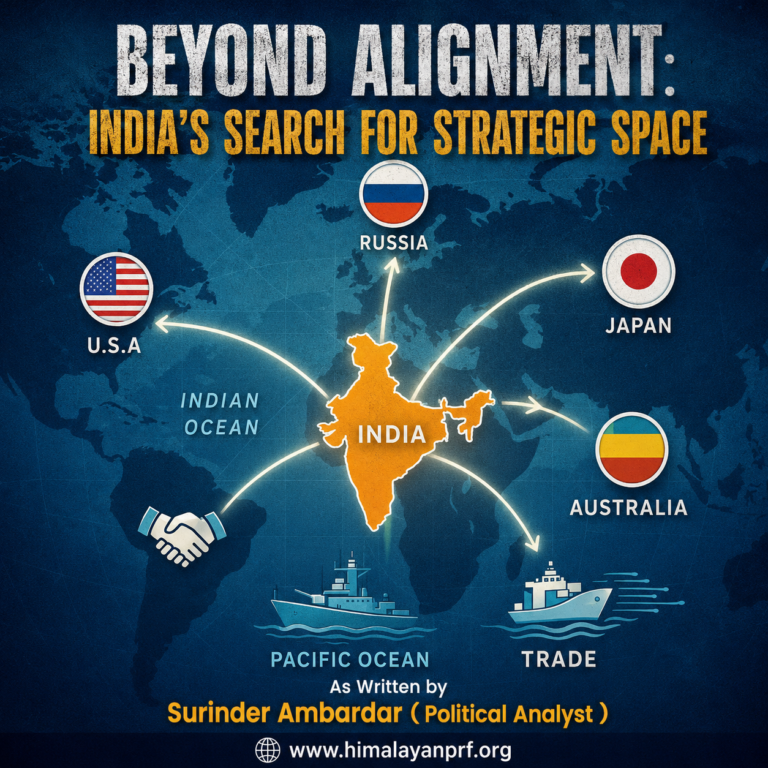
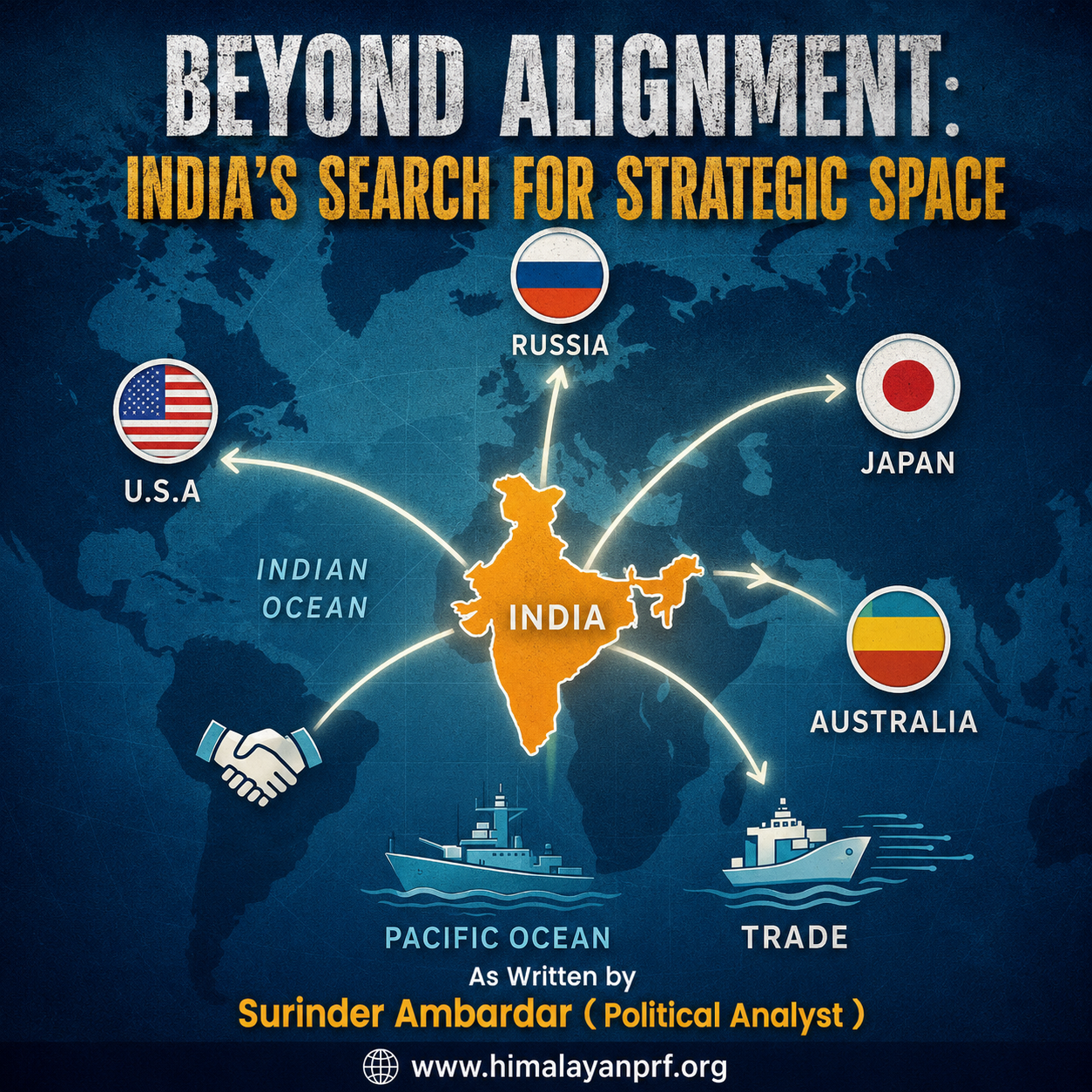
Beyond Alignment: India’s Search for Strategic Space
Written by: Surinder Ambardar ( Political Analyst )
The contemporary world presents an irony that international politics has rarely encountered with such intensity. At the very moment when globalization promised unprecedented interconnectedness, the international order has increasingly become fragmented, suspicious, and strategically exclusionary. Trade, once imagined as the language of mutual prosperity, is now frequently weaponised; supply chains have become instruments of geopolitical coercion; technology flows are increasingly regulated through the prism of national security; and sovereignty itself appears subject to the invisible hierarchies of global power. The world no longer speaks the language of seamless interdependence. It speaks instead in the guarded vocabulary of strategic distrust.
In such a world, states are compelled to negotiate a difficult paradox: how to remain economically integrated without becoming strategically vulnerable. The old binaries of alliance and neutrality no longer sufficiently explain state behaviour. What emerges instead is a politics of calibrated autonomy, where countries seek engagement without dependence and partnerships without surrendering sovereign agency.
India’s contemporary foreign policy must be situated within this larger structural transformation. If the Cold War was defined by military blocs and ideological rigidity, the present international moment is increasingly defined by geo-economics, technological competition, and the strategic reconfiguration of supply chains. In this evolving order, India’s recent diplomatic engagements- particularly the Prime Minister’s multi-country outreach involving the United Arab Emirates, the Netherlands, Sweden, Norway, and Italy, deserve to be understood not merely as ceremonial diplomacy or economic outreach, but as an attempt to architect strategic resilience in an uncertain world.
To dismiss these visits as routine diplomatic exercises would be to misunderstand the discourse of contemporary power. Diplomacy today is no longer confined to symbolic handshakes or carefully choreographed communiqués. It increasingly concerns access to energy corridors, semiconductor ecosystems, technological partnerships, infrastructure financing, maritime routes, and resilient supply chains. The battlefield of geopolitics has quietly shifted from territorial conquest to economic positioning.
At one level, India’s diplomatic posture reflects continuity. Since independence, Indian foreign policy has historically cherished the idea of strategic autonomy- an instinct deeply
embedded in its diplomatic imagination. Yet strategic autonomy today cannot merely signify political distance from rival power blocs. It requires material capabilities, diversified partnerships, and economic resilience. Autonomy without capability risks becoming rhetorical idealism. Sovereignty without economic strength often becomes symbolic sovereignty.
This perhaps explains the significance of India’s recent diplomatic engagements. These visits were not simply about bilateral warmth or expanding trade volumes. They represented a deeper attempt to create what may be described as “strategic windows” through which India seeks to navigate a fractured world order without becoming captive to any singular geopolitical arrangement.
The visit to the United Arab Emirates illustrates this logic with considerable clarity. Traditionally perceived through the limited prism of labour migration and remittances, India-UAE relations have now acquired profound strategic depth. The agreement concerning approximately 30 million barrels of strategic oil reserves, alongside long-term energy partnerships involving LNG and LPG procurement, is not merely an economic arrangement. It reflects India’s attempt to secure insulation against energy volatility in a world where conflicts increasingly disrupt supply networks.
Energy security, after all, is national security by another name. The experience of the Russia-Ukraine conflict demonstrated how rapidly global markets can destabilise domestic economies. For a country like India, heavily dependent on energy imports, securing diversified and long-term arrangements becomes essential not only for economic stability but for strategic flexibility. The UAE’s proposed investments in Indian infrastructure, amounting to billions of dollars, similarly reveal a pragmatic recognition that economic partnerships must produce tangible developmental dividends.
Yet one must resist celebratory excess. Economic partnerships are only as transformative as institutional execution permits them to be. India’s challenge has historically not been diplomatic imagination but bureaucratic implementation. Foreign investments often encounter domestic friction- regulatory complexity, procedural uncertainty, and infrastructural delays. Strategic intent, therefore, must be matched by administrative competence.
The Netherlands partnership represents another equally important dimension of India’s strategic repositioning: technological sovereignty. In contemporary geopolitics, semiconductors have emerged as the nervous system of modern economies. Whoever controls semiconductor ecosystems increasingly controls technological power.
The collaboration involving semiconductor manufacturing and advanced technology partnerships signals India’s recognition that dependency in critical technologies creates structural vulnerability. The disruptions witnessed during the pandemic exposed how dangerous excessive import dependency could become. Supply chain interruptions affected
everything from electronics to automobile manufacturing, reminding states that economic vulnerability often translates into strategic vulnerability.
India’s efforts to build semiconductor capabilities through partnerships with technologically advanced countries therefore represent more than industrial policy; they reflect an emerging doctrine of technological self-strengthening. Artificial intelligence and green technology collaborations further indicate that India seeks not merely participation in future economies but relevance within them.
Yet difficult questions remain. Can India genuinely become a competitive manufacturing hub without simultaneously reforming education, innovation ecosystems, and industrial infrastructure? Technology transfer agreements alone do not automatically produce technological ecosystems. Nations rise technologically not simply through agreements but through sustained investment in research capacities, institutional excellence, and scientific imagination.
Sweden’s role in India’s diplomatic outreach similarly deserves closer examination. The strategic partnership upgrade and collaboration in emerging technologies reveal India’s recognition that twenty-first century influence increasingly depends upon technological capability rather than merely military strength. Countries that dominate innovation ecosystems increasingly shape global norms.
For India, partnerships with technologically sophisticated societies such as Sweden represent opportunities to reduce dependency and accelerate domestic capacity building. Yet such partnerships also reveal a larger anxiety shaping Indian foreign policy: the fear of technological marginalisation. In an era driven by automation, artificial intelligence, and digital governance, countries incapable of technological adaptation risk permanent strategic disadvantage.
But partnerships alone cannot substitute domestic reform. India’s aspirations for technological leadership require difficult internal conversations concerning educational quality, institutional decay, scientific investment, and policy coherence. Strategic ambition cannot indefinitely coexist with institutional fragility.
Norway, often overlooked in mainstream diplomatic discourse, carries its own strategic significance. The Prime Minister’s visit after decades reflects recognition that partnerships concerning infrastructure, sustainability, maritime cooperation, and green transitions matter deeply in the emerging global economy.
Infrastructure investment remains central to India’s developmental imagination. The promise of large-scale economic engagement potentially creates opportunities for employment generation and capital infusion. Yet beyond economics lies a subtler geopolitical logic: diversification.
One of the recurring anxieties in international relations concerns overdependence. Countries excessively dependent upon singular markets, technologies, or investment sources often find their strategic autonomy compromised. India’s outreach to countries like Norway suggests an attempt to diversify economic relationships sufficiently to avoid structural dependence upon any one actor.
This instinct reflects prudence. The international system increasingly rewards flexibility. In a fragmented world order, excessive alignment often creates vulnerability. Perhaps nowhere is the geopolitical significance of India’s outreach more visible than in the Italy connection through the India-Middle East-Europe Economic Corridor (IMEC). If previous partnerships primarily concerned investment and technology, IMEC concerns geography itself.
Historically, geography has always shaped political imagination. Trade routes determine influence; maritime corridors define strategic leverage; connectivity shapes economic destiny. China’s Belt and Road Initiative fundamentally altered global infrastructure politics by creating expansive connectivity networks across continents. For many countries, this generated both opportunity and anxiety.
India’s involvement in IMEC represents an attempt not merely to participate in global trade but to reshape its architecture. The corridor seeks to position India as a critical node connecting Europe, the Middle East, and Asia through integrated infrastructure, logistics, energy corridors, and digital connectivity.
In geopolitical terms, IMEC represents more than commerce. It is a strategic proposition. It signals India’s unwillingness to remain peripheral in shaping future trade architectures. It represents an assertion that alternative connectivity models are possible- models rooted not in hegemonic dependency but diversified partnership.
Yet realism demands caution. Grand corridors have historically suffered from overpromising and under-delivering. Political instability, financing challenges, regional tensions, and competing geopolitical interests often delay implementation. IMEC’s success will ultimately depend not upon diplomatic declarations but institutional persistence.
Nevertheless, to ignore the broader significance of these diplomatic engagements would be intellectually limiting. Together, they reveal an important transformation in India’s external outlook. Foreign policy increasingly appears informed by a recognition that economic capability and strategic influence are inseparable.
The language of power itself is changing. Military strength remains important, but economic resilience, technological capability, supply chain access, and infrastructural connectivity increasingly define national influence. Countries no longer merely compete through armies; they compete through ports, chips, energy reserves, digital systems, and trade networks.
India’s diplomatic posture appears increasingly attentive to this reality. But one must also confront an uncomfortable truth. Strategic positioning cannot become a substitute for domestic transformation. There exists a persistent temptation in political discourse to mistake diplomatic success for developmental inevitability. International agreements create opportunities, not outcomes. Outcomes depend upon domestic institutions.
India’s ambition for a developed future- often articulated through the language of Viksit Bharat- cannot rely solely upon external partnerships. It requires internal preparedness: governance reforms, institutional accountability, technological literacy, educational investment, and industrial competitiveness. Without these foundations, even the most ambitious international partnerships risk becoming symbolic rather than transformative.
Yet despite these limitations, something important must be acknowledged. India’s contemporary diplomacy increasingly reflects confidence rather than hesitation. For decades, India often approached global politics defensively- caught between aspiration and limitation. Today, its diplomatic posture suggests a country seeking not merely accommodation within global structures but influence over their direction.This matters.
The significance of the Prime Minister’s recent visits lies not simply in memorandums of understanding or investment commitments. Their deeper importance rests in what they symbolise: an attempt to secure India’s place within a rapidly changing world order without sacrificing strategic autonomy.
In an age where trade is weaponised, technologies are securitised, and global institutions increasingly struggle to mediate competing interests, silence is rarely an option. Nations that fail to strategically position themselves risk becoming spectators to transformations that reshape their futures.
India’s outreach to the UAE, Netherlands, Sweden, Norway, and Italy suggests an understanding of this historical moment. Whether through energy security, technological cooperation, infrastructure investment, or alternative trade corridors, these partnerships collectively represent an effort to widen India’s strategic room for manoeuvre.
The challenge ahead is formidable. Diplomatic vision must now encounter administrative execution. Strategic imagination must be matched by institutional seriousness. Partnerships must evolve into capabilities.
If these engagements are sustained with coherence and domestic reform, they may indeed become foundational to India’s developmental aspirations. But their greatest significance perhaps lies elsewhere: in signalling that India no longer seeks merely to adapt to changing global realities; it seeks, however cautiously, to shape them.
That, ultimately, is the real measure of strategic maturity.
About the Author