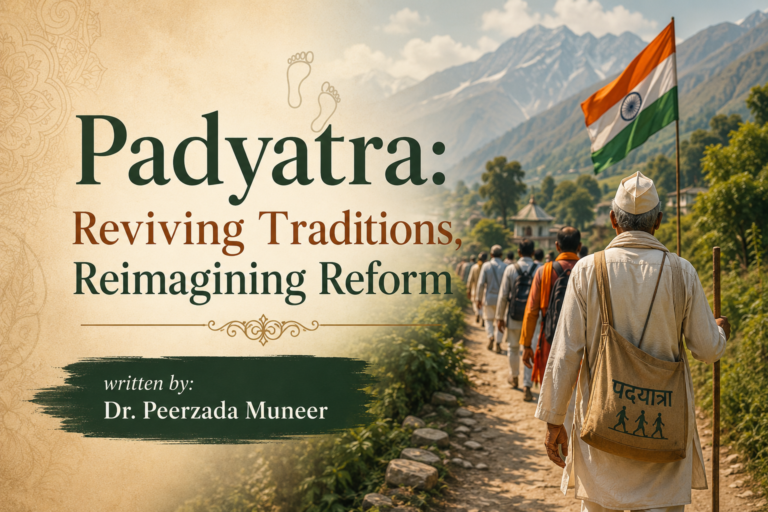
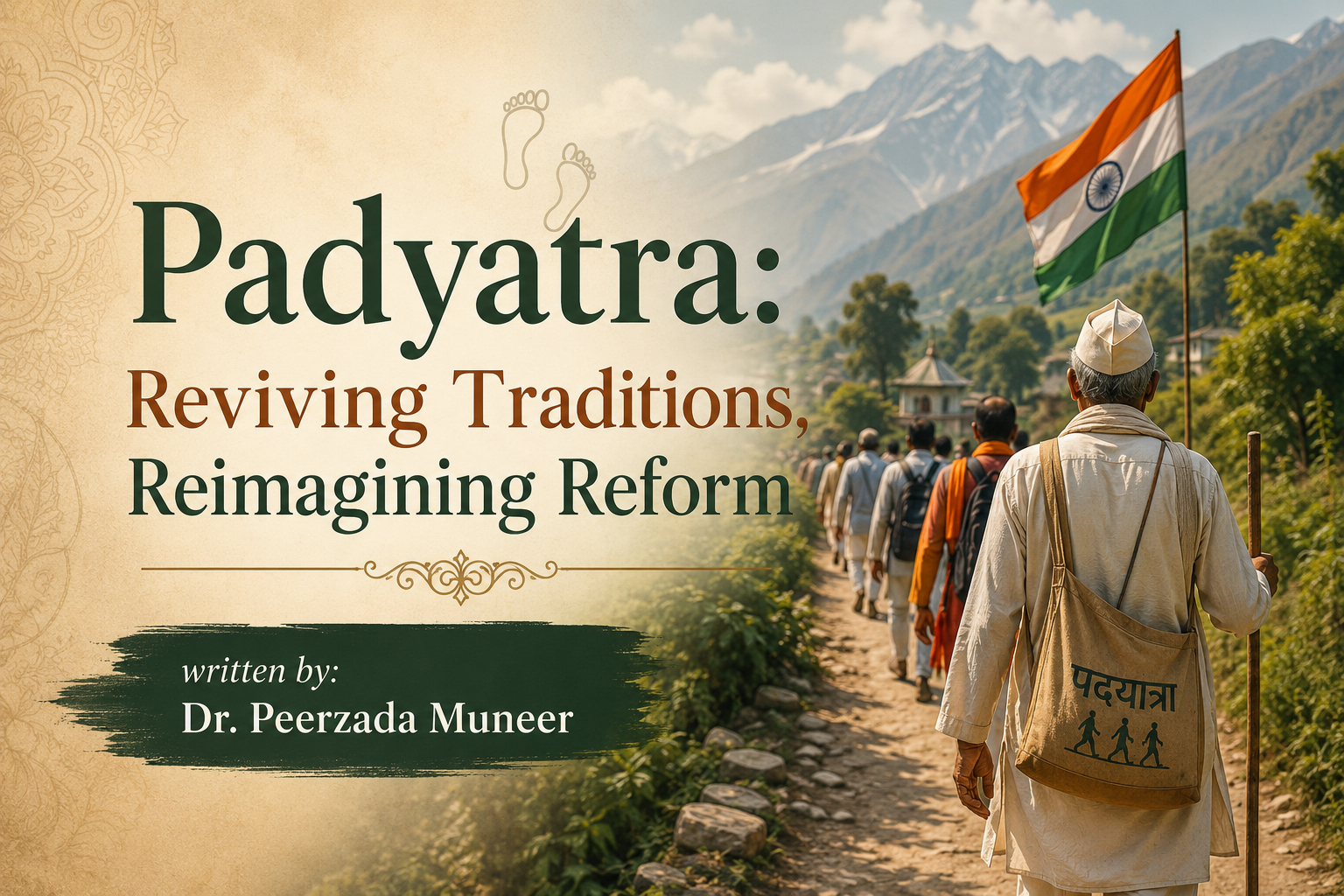
Padyatra: Reviving Traditions, Reimagining Reform
Written by: Dr. Peerzada Muneer
The meaning and religious roots of walking
A pad yatra literally means a journey on foot, from pada, foot, and yatra, journey. Yet in the Indian civilizational imagination, it is never merely walking. It is a moral act, a vow, a discipline of the body, and a public declaration of inward seriousness. Its deepest roots lie in the older idea of tirtha-yatra, a journey to a tirtha, or crossing place. Oxford Bibliographies explains that tirthayatra means a journey to a crossing place where one may come into contact with sacred forces not ordinarily encountered in everyday life. This idea is central: the pilgrim is not only moving from one place to another, but crossing from ordinary habit into heightened awareness, from social separateness into community, and from moral numbness into responsibility. (OUP Academic)
In Hindu thought, the earth itself becomes a sacred text. Rivers, mountains, forests, temples, shrines, samadhis, and routes walked by saints carry memory and meaning. Diana Eck’s work on India’s sacred geography shows how pilgrimage, sacred space, embodiment, plurality, temple practice, and saintly memory together shape the Indian religious imagination. A pad yatra therefore belongs to a worldview in which place is not inert and the body is not secondary. The feet become instruments of devotion. Fatigue becomes a form of humility. Distance becomes meditation. Dust, heat, hunger, chanting, silence, and companionship become part of the pilgrim’s education. (OUP Academic)
This is why India’s great walking traditions, such as the Pandharpur Wari in Maharashtra, have endured across centuries. In the Wari, varkaris walk for days toward Pandharpur, singing the poetry of saints and carrying the memory of bhakti into public life. Such journeys are devotional, but they are also social. They produce equality, because the wealthy and the poor walk the same road. They produce discipline, because the body must submit to rhythm and restraint. They produce community, because strangers eat, sing, pray, and suffer together. The yatra becomes a temporary republic of shared faith.
The same sacred grammar appears across religions, even when the theology differs. In Islam, Hajj is one of the Five Pillars and is obligatory for Muslims who are physically and financially able. Its rites include deeply embodied acts: tawaf, the circumambulation of the Kaaba, and sa’i, the walking between Safa and Marwa. The Saudi Ministry of Hajj and Umrah describes tawaf as walking seven times around the Kaaba, while Britannica emphasizes Hajj’s centrality in Muslim religious life. The meaning is submission, remembrance, purification, and equality before God. The pilgrim’s body enters a discipline in which dress, movement, prayer, and restraint dissolve ordinary markers of status. (Encyclopedia Britannica)
Islam also has powerful walking traditions beyond Hajj. The Arbaeen pilgrimage to Karbala, especially among Shia Muslims, is one of the largest walking pilgrimages in the world. A study in Religions describes how attachment to Imam Hussain becomes attachment to a sacred route, producing feelings of unity, transformation, and religious loyalty among pilgrims. This has a striking similarity with pad yatra: the road is not simply a route, but a carrier of memory, sacrifice, grief, devotion, and moral renewal. (MDPI)
Christianity too has its walking pilgrimages. The Camino de Santiago in Spain is among the most famous. Contemporary research on the Camino shows that pilgrims often experience it as a spiritual journey, not merely as travel. Another study on transformative aftereffects among Camino pilgrims found reported shifts toward love, unity with nature, sharing of insights, spirituality, wisdom, and reduced materialism. Here again, walking becomes an antidote to ego, speed, and consumerism. The pilgrim leaves behind excess luggage, both literal and mental, and rediscovers the simple human truths of endurance, dependence, gratitude, and fellowship. (Springer Link)
In Buddhism, Tibetan kora, or circumambulation around a sacred place or object, is a meditative walking practice. It is understood as a way of generating merit and cultivating awakening. In Jainism, tirtha-yatra also means going to a sacred place, and Jainpedia notes that, in earlier times, pilgrimage was naturally understood as the whole journey on foot. In Sikh practice, the nagar kirtan takes sacred singing and the Guru’s message into the streets, creating a mobile religious community through music, service, and public participation. These examples show that the pad yatra belongs to a global religious family of sacred walking. The names differ, but the principle remains: the feet train the heart. (Tibetan Nuns Project)
Philosophy, psychology, and the social power of yatra
The philosophy of pad yatra rests on a profound insight: human beings are transformed not only by ideas, but by embodied practice. A lecture may inform, a slogan may excite, a policy may instruct, but a journey on foot changes tempo, attention, and relationship. Walking slows the mind. It makes one vulnerable to weather, terrain, strangers, and fatigue. It breaks the illusion of control. It teaches patience because the destination cannot be reached instantly. It teaches equality because all walkers, however powerful, must obey the same bodily limits. It teaches humility because the road is larger than the individual.
This is why walking has been central not only to religion but also to reform. Gandhi’s Salt March of 1930 remains the greatest modern example in India. Britannica records that Gandhi’s march from Sabarmati to Dandi was a major nonviolent protest against British salt laws and became the opening act of a wider civil disobedience movement. Its brilliance lay in transforming a common substance, salt, into a universal moral symbol. By walking, Gandhi turned law into conscience, politics into penance, and resistance into public education. The march made injustice visible because it unfolded slowly, village by village, allowing people to join not merely an agitation but a moral drama. (Encyclopedia Britannica)
Vinoba Bhave’s Bhoodan movement extended the same spirit after Independence. He walked through India asking landowners to donate land for the landless. The Mahatma Gandhi portal records that, over twenty years, Vinoba walked across the length and breadth of India and persuaded landowners to donate millions of acres. Whether or not all donated land was finally transferred effectively, the moral imagination of Bhoodan remains extraordinary: instead of seizing land by force, it tried to awaken conscience through presence, persuasion, and renunciation. (Mahatma Gandhi Website)
The same walking symbolism appears outside India. The Selma to Montgomery march in 1965, led by Martin Luther King Jr. and other civil rights leaders, became a landmark in the American civil rights movement and directly contributed to the passage of the Voting Rights Act. Here too, walking exposed injustice. The marchers’ disciplined vulnerability forced a nation to confront the violence of segregation and the moral urgency of democratic rights. (Encyclopedia Britannica)
Anthropologically, pad yatra works because it creates what Victor Turner famously called communitas, a heightened sense of human togetherness that arises in liminal situations, when people temporarily step outside ordinary hierarchies. Later scholarship has debated and refined Turner’s concept, but its usefulness remains clear. A yatra suspends routine. It brings officials, saints, students, workers, women, elders, and youth into a shared movement. It converts spectators into participants. It generates memory through repetition: steps, slogans, prayers, halts, conversations, and shared meals. (digitalcommons.wcupa.edu)
Psychologically, a pad yatra is powerful because it communicates sincerity without needing excessive speech. In a world flooded by digital campaigns, advertisements, press releases, and online outrage, walking retains a rare credibility. It is slow in an age of speed, bodily in an age of screens, collective in an age of loneliness, and disciplined in an age of distraction. It asks people to give time, not merely attention. This is why old values can be reused, not as nostalgia, but as living tools for postmodern challenges.
The postmodern condition is marked by fragmentation, addiction, ecological anxiety, mental health crises, distrust of institutions, and the collapse of shared moral vocabulary. Pad yatra offers a counter-practice. It restores locality by entering neighbourhoods. It restores community by gathering bodies in public space. It restores moral seriousness by requiring effort. It restores listening because a journey creates encounters, not only speeches. It restores memory because every route carries stories. When used sincerely, the pad yatra becomes a bridge between tradition and modern policy, between religious memory and civic reform.
Yet its spirit must be protected. A pad yatra is not a crowd-management exercise. It is not a photo opportunity. It is not merely a leader walking in front while people follow in silence. Its inner requirements are humility, service, nonviolence, listening, inclusion, restraint, and follow-up. The classical pilgrim does not dominate the path; he submits to it. Similarly, a public yatra must not merely pass through people. It must allow people to speak, confess pain, seek help, and participate in the solution. Only then does walking become transformation rather than performance.
LG J&K’s Nasha Mukt Pad Yatras: relevance, impact, and constructive criticism
Seen in this wider civilizational frame, the recent pad yatras led by Lieutenant Governor Manoj Sinha under the Nasha Mukt Jammu Kashmir Abhiyaan are culturally and psychologically significant. The national Nasha Mukt Bharat Abhiyaan was launched by the Ministry of Social Justice and Empowerment on August 15, 2020, and now works across districts with prevention, awareness, counselling, treatment, rehabilitation, aftercare, and community engagement. The J&K campaign’s 100-day intensified phase was launched in April 2026, with the LG flagging off and joining pad yatras as part of a mass mobilisation against drug abuse. (dosje.gov.in)
Its importance lies in converting an administrative concern into a social and moral movement. Drug abuse is not only a policing issue. It is a wound in family life, youth culture, mental health, local economy, and social trust. In J&K, where insecurity, trauma, unemployment, trafficking networks, and border vulnerabilities complicate the problem, a purely bureaucratic response would remain insufficient. A pad yatra publicly breaks the silence around addiction. It tells parents, teachers, imams, pandits, granthis, doctors, police, panchayats, youth clubs, and women’s groups that society must walk together if it wants to heal together.
Religiously, the form is meaningful because J&K is a land of shrines, Sufi memory, temple routes, Sikh service, and community gatherings. The yatra form resonates across these traditions. Culturally, it fits the Indian habit of treating moral reform as collective movement. Psychologically, it reduces shame. When an anti-drug message enters streets and villages through a shared walk, addiction is no longer hidden only inside homes. It becomes discussable, and what becomes discussable can become treatable.
The encouraging part of the initiative is its effort to combine awareness with enforcement and rehabilitation. Reports from the campaign have highlighted women’s committees, youth clubs, helpline calls, treatment facilities, inspections of drug stores, arrests of alleged traffickers, and property action against drug networks. At its best, this reflects a whole-of-society model, where the addict is treated with compassion while traffickers face law. (Daily Excelsior)
The constructive criticism is equally important. The spirit of pad yatra will be maintained only if compassion remains as visible as enforcement. A dependent user must not be socially branded as an enemy. The language of war against narcotics may be useful against trafficking networks, but it should not erase the difference between a smuggler and a young victim of addiction. The campaign must therefore keep due process, medical treatment, confidentiality, counselling, relapse support, family therapy, and reintegration at its centre. Public pledges are valuable, but recovery happens quietly, over months and years.
The initiative should also publish periodic outcomes, not only activities: how many people entered treatment, how many completed rehabilitation, how many families received counselling, how many schools adopted prevention modules, how many legal actions survived scrutiny, and how many recovered youth returned to education or work. Recovered persons, mothers, teachers, doctors, religious leaders, and social workers should walk alongside officials, so that the yatra becomes not only state-led but society-owned.
In letter, the LG’s pad yatras clearly follow the form: walking, public pledge, collective participation, symbolic route, and moral appeal. In spirit, they will be most successful if they become less about authority leading a crowd and more about society recovering its conscience. A true pad yatra does not end at the destination. It creates a path that people continue to walk after the leader has left. If Nasha Mukt J&K can combine sacred cultural memory with scientific rehabilitation, firm law with human dignity, and public mobilisation with sustained care, it can become a civic pilgrimage from fear to responsibility, from addiction to recovery, and from silence to collective moral courage.
About the Author