Narco-Terrorism, Hybrid Warfare, and the Counter-Mobilisation in Jammu & Kashmir
Written By: Irshad Ahmad Bhat (Research Scholar)
In Jammu & Kashmir, narcotics are not a social crisis with geopolitical implications. They are a geopolitical weapon with social consequences — deployed against a society made maximally vulnerable by decades of trauma, economic despair, and fractured community bonds.
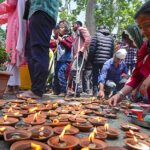
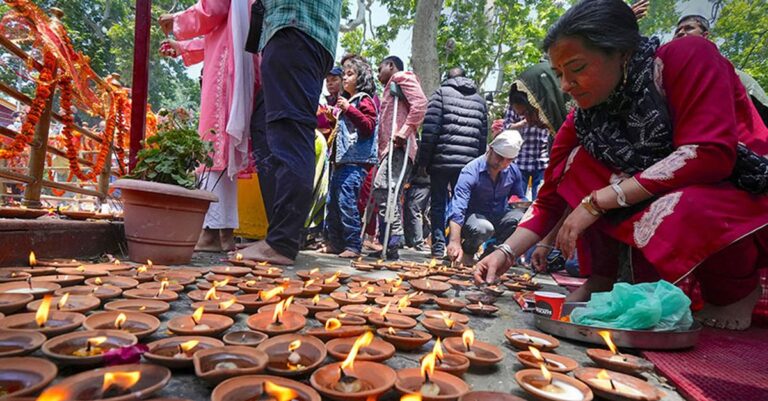
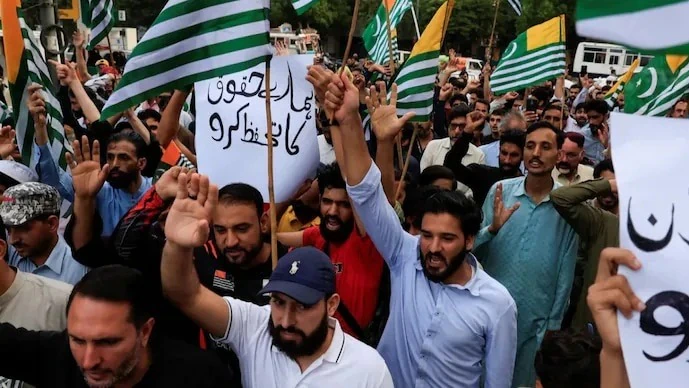
When Lieutenant Governor Manoj Sinha led tens of thousands of citizens from TRC Football Ground to Lal Chowk on May 3 — flanked by ulema and NCC cadets, mohalla committees and women’s vigilance panels, traders and teachers — he was not inaugurating an awareness campaign. He was responding to an act of war. The padyatra, the largest of its kind in a generation, was the most visible expression yet of a social compact between an administration and its people against an adversary that has long deployed heroin as a calculated instrument of territorial conquest. Understanding what the Nasha Mukt Bharat Abhiyan (NMBA) is actually fighting requires confronting a two-layered truth: J&K’s drug crisis is simultaneously a symptom of decades of internal psychological and economic wounding, and the deliberate product of an external hybrid warfare strategy. The NMBA — the most ambitious counter-narcotics mobilisation J&K has seen — must address both or ultimately defeat neither.
Yet addressing both layers demands a third insight that is often elided in security-focused accounts: no policy, however well-resourced its enforcement apparatus or however compassionately designed its rehabilitation architecture can succeed without deep grassroots mobilisation and the active participation of both formal and informal networks across society. This is not a peripheral observation. It is the structural truth of a society like J&K, which is not atomistic in the Western liberal sense. J&K is an embedded society — one in which identity, obligation, moral authority, and trust flow through kinship networks, religious institutions, neighbourhood bonds, and inter-generational relationships. Policy that bypasses these networks does not merely underperform; it fails to reach the terrain on which the battle is actually being fought.
SCALE OF THE CRISIS: SUBSTANCE DEPENDENCY IN J&K
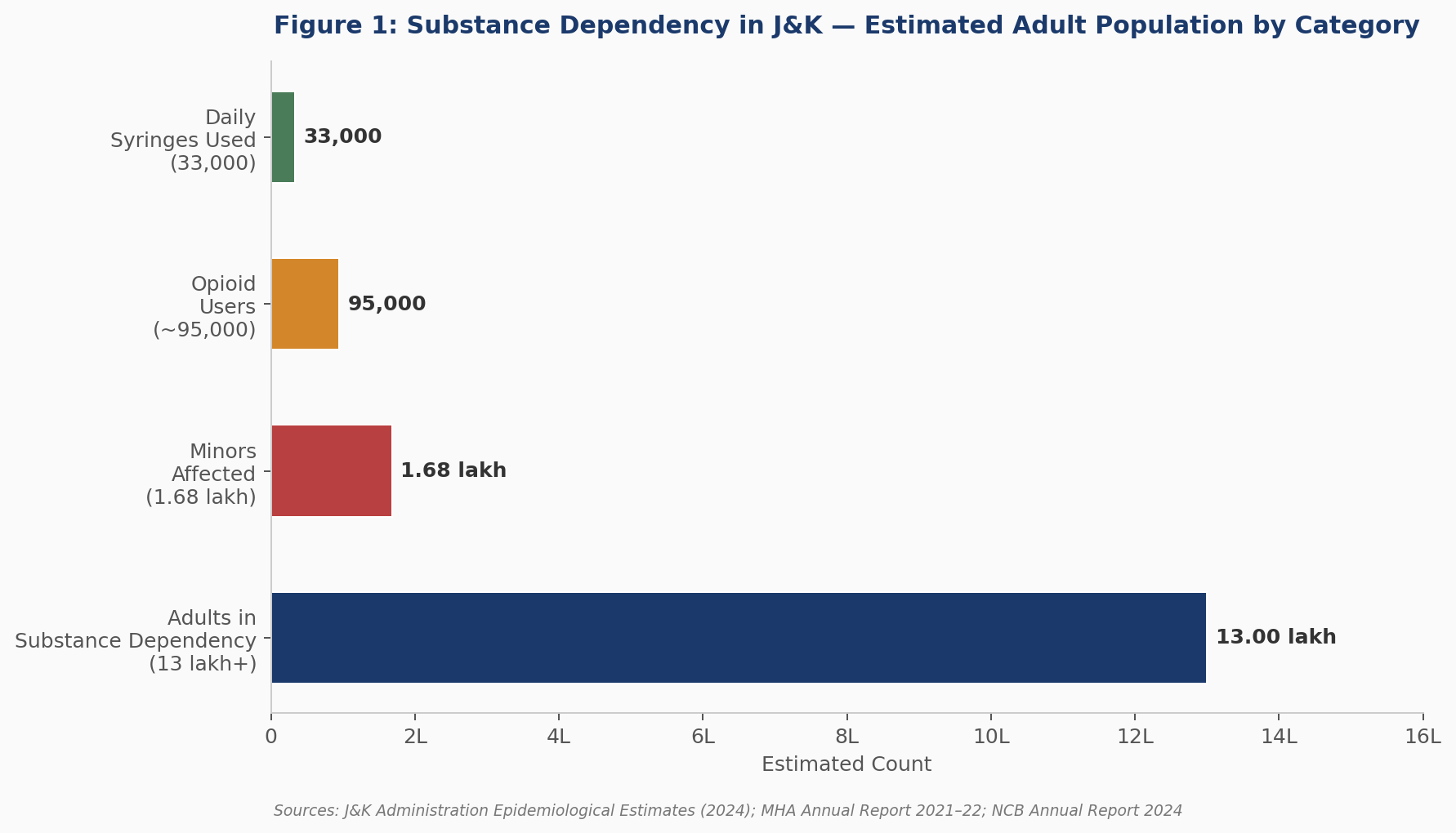
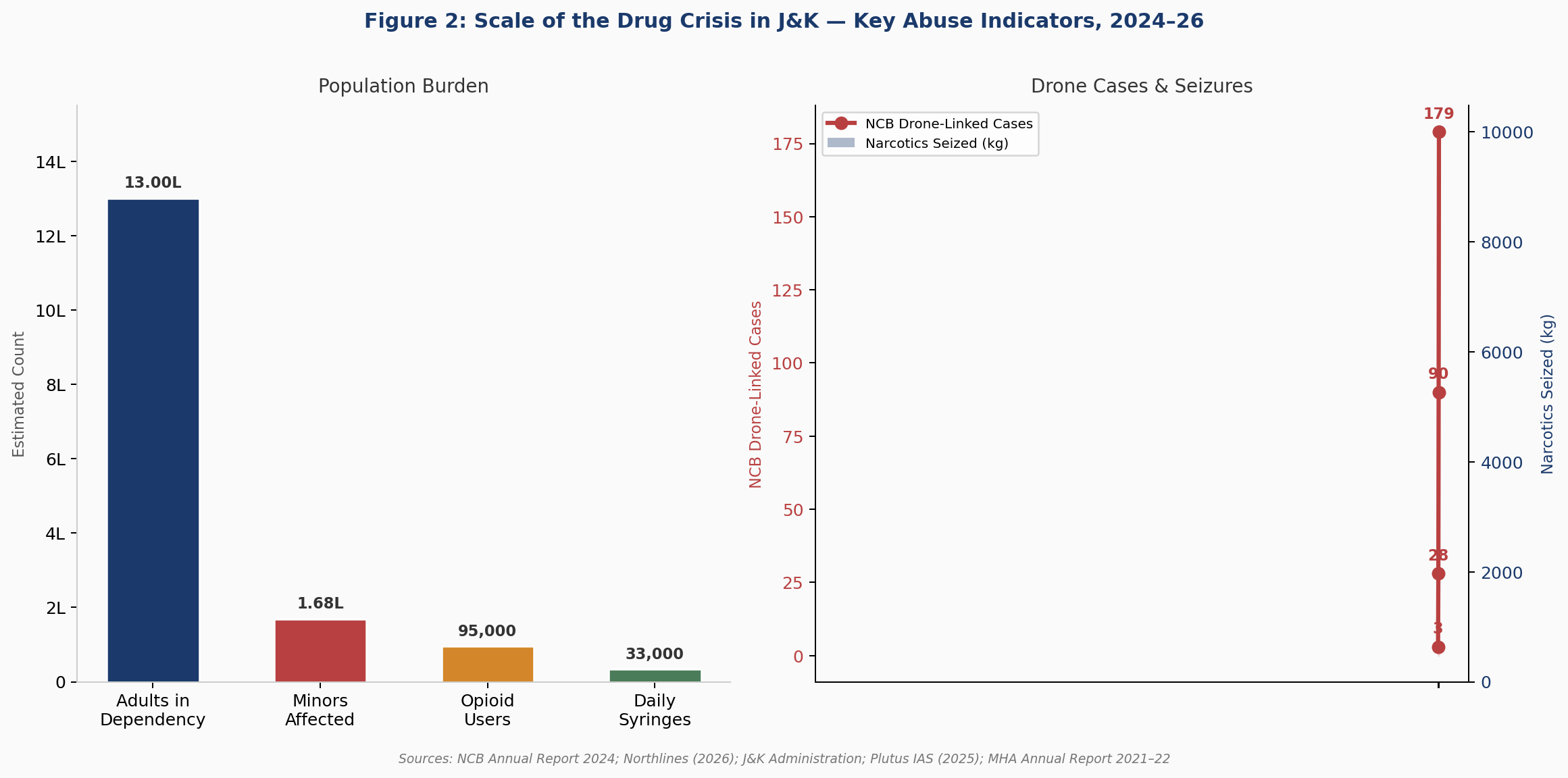
The epidemiological scale is staggering: over 13 lakh adults in substance dependency, 1.68 lakh minors affected, approximately 95,000 on opioids, and 33,000 syringes used daily across the Union Territory. These numbers would constitute a public health emergency anywhere. In J&K, they are also a diagnostic — each figure pointing not merely to an adversary’s calculation but to decades of accumulated injury that made the community receptive to the drug before a single consignment crossed the Line of Control.
A Society Wounded Before the Drug Arrived
Kashmir has lived under continuous armed conflict since 1989. The psychiatric consequences of that duration are clinically documented with unusual rigour. Margoob and Sheikh (2006) established a PTSD prevalence of 15.9 percent across the Kashmiri adult population — a figure the study’s own authors described as “quite alarming.” By 2007, Srinagar’s sole psychiatric facility, which had received 1,700 visitors in 1990, was recording over 100,000 annual patients — representing only a fraction of actual need given deep stigma around mental health care in the Valley. Jong et al. (2008), publishing in Conflict and Health, documented that populations enduring prolonged organised violence exhibit elevated rates of depression, anxiety disorders, social phobia, PTSD — and, critically, substance use as a coping mechanism.
The clinical literature is unambiguous on what follows. Bhat and Imtiaz (2017) found that most drug users in the Valley consume substances in the certainty that it will lessen their troubles like trauma, stress, anxiety, or depression — self-medication as a rational response to an environment in which formal psychological support has been chronically absent. A PMC-indexed study documented that participants explicitly named job and financial losses and boredom due to prolonged curfews as precipitating factors in initiation, and that current conflict was one of the factors in both substance initiation and treatment discontinuation — a recursive trap from which individual willpower alone cannot extract a person. Yaqoob and Ashraf (2022) confirmed this multi-causal architecture: conflict exposure, peer pressure, unemployment, disrupted education, and chronic psychosocial stress operate together as the soil in which addiction takes root.
The economic dimension is structurally significant and consistently underweighted. Rather et al. (2013) documented that economic marginalisation, social dislocation, and the collapse of family structures under conflict pressure are among the most consistent predictors of substance use disorder in the Valley. In this context, the absence of grassroots mobilisation is not simply a missed opportunity — it is a structural vacuum that the drug economy readily fills. The NMBA’s instinct to close that vacuum through community engagement is therefore not merely administratively sound; it is strategically essential.
The weapon is designed for the wound. The narco-economy targets J&K strategically — because a society pre-loaded with psychological injury, economic despair, and fractured social bonds is a society maximally vulnerable to the drug’s penetration. But the same embeddedness that makes it vulnerable also holds the key to its recovery.
THE ARCHITECTURE OF A SILENT WAR
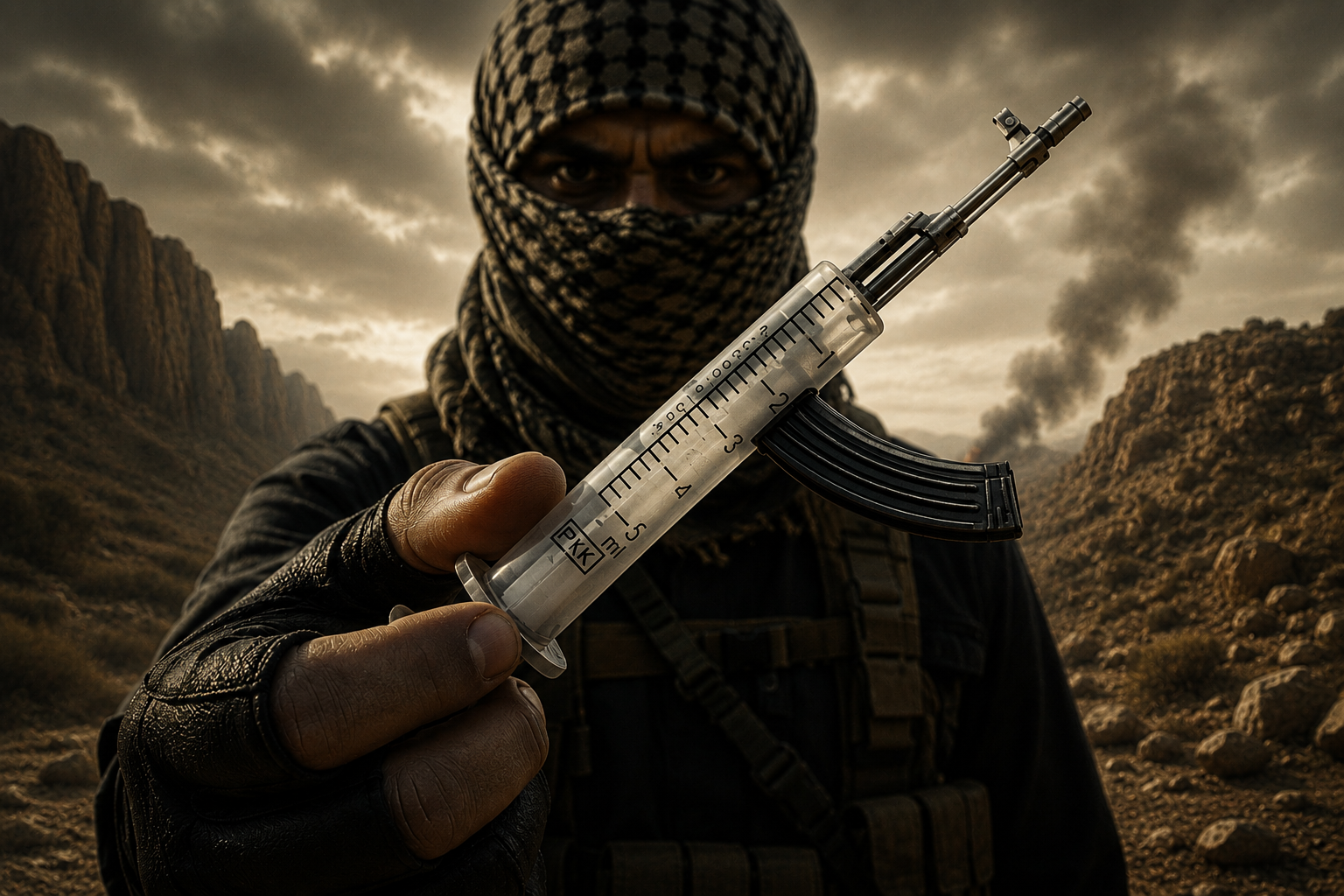
The adversary’s use of narcotics as a weapon of hybrid warfare is documented, not asserted. Frank Hoffman (2007), whose monograph remains the field’s canonical reference, defined hybrid warfare as the simultaneous deployment of conventional capabilities, irregular tactics, terrorist acts, and criminal disorder to achieve political objectives below the threshold of formal conflict. Narco-trafficking in J&K is not a criminal externality of this doctrine — it is one of its most precisely calibrated components. As a Member of Parliament from J&K argued before the Rajya Sabha in March 2026: having failed to fracture community morale through conventional terrorism, the adversary has adopted a “silent war” strategy, pushing narcotics as the continuation of proxy conflict by other means.
Former Director General of Police R. R. Swain stated without qualification that narco-terrorism is the biggest threat in the Union Territory, and that drug proceeds have been directly channelled to fund active terror groups. DGP Nalin Prabhat, in December 2025, framed drug traffickers, terror operatives, and hawala operators as components of a single ecosystem requiring a single counter-campaign. The J&K High Court gave this convergence its most authoritative judicial articulation in July 2025: narco-terrorism has evolved into a new front of proxy war, with adversaries using narcotics as terror currency to destabilise India’s social and economic fabric.
The operational evidence confirms the doctrinal picture. Security forces seized 21,265 kg of narcotics over the three years 2023–2025, including 4,491 kg in 2025 alone. Border agencies recovered 292 drones at the border in 2025, while NCB drone-linked narcotics cases rose from just 3 in 2021 to 179 in 2024 — a roughly sixty-fold increase. Joint Army and Police operations have recovered consignments carrying Afghan-variety narcotics alongside AK-56 rifles, hand grenades, and IED detonators through the same logistics chain. The drugs and weapons are not separate consignments sharing a corridor. They are components of the same strategic payload.
What the adversary understands — and what the NMBA’s architects have correctly grasped — is that a weapon deployed through society can only be countered through society. An enforcement apparatus, however powerful, operates at the surface of social life. The narco-trafficking ecosystem embeds itself in the informal economy, in neighbourhood trust networks, in the spaces between families and mohallas. Reaching those spaces requires the active agency of community institutions: the imam at Friday prayer, the woman leader in the vigilance panel, the teacher with sustained contact with a generation at risk. These are not supplementary actors in the counter-narcotics campaign. They are its primary substrate.
WHY ENFORCEMENT ALONE CANNOT WIN
The NMBA’s first 21 days — 481 FIRs, 518 arrests, 24 property demolitions, and 157 CCTV installations — are significant achievements by any measure. Enforcement decapitates distribution nodes and imposes costs on the narco-ecosystem. But it cannot, on its own, address the trauma, the unemployment, the broken family structures, or the social disorganisation that make communities permeable to addiction’s return once a network is disrupted. The administration’s dual-track design — pairing rigorous enforcement with rehabilitation and community mobilisation — reflects a sophisticated understanding of this limit.
Ferdinand Tönnies (1887/2001) established that in Gemeinschaft social formations — communities held together by kinship, shared belief, and organic moral bonds — social regulation operates through thick institutions: the family, the mosque, the neighbourhood, the inter-generational network. Robert Putnam (2000) demonstrated that these formations generate the bonding social capital that makes norms binding without recourse to the state. This is precisely the structure of J&K’s society. It is not atomistic. It is embedded. Policy that treats the individual in isolation from these networks not only misses the primary vectors of both vulnerability and recovery — it concedes the most powerful terrain to the adversary.
The comparative evidence confirms both the limit and the remedy. In the Philippines, a USAID-evaluated community-based rehabilitation programme across twelve local government units produced superior clinical outcomes at lower cost than inpatient state facilities precisely because it embedded treatment within existing social networks.] Thailand’s Integrated Drug Abuse Prevention Project across 85 tribal villages showed measurable reductions in active users — but a six-month follow-up found outcomes degraded when external support withdrew and community engagement was not institutionally sustained. The lesson is consistent: mobilisation that is not structurally embedded eventually atrophies. In an embedded society, the community is not the backdrop to the policy. It is the policy.
THE NMBA AS SOCIAL RESTORATION
The Nasha Mukt Bharat Abhiyan’s design in J&K — 3,000 religious leaders, Waqf institutions, mohalla committees, 1,670-strong women’s vigilance panels in Rajouri alone, Nambardar and Chowkidar networks — is a systematic attempt to restore precisely the Gemeinschaft formations that conflict has eroded, while simultaneously deploying them as the primary counter-narcotics infrastructure. The 30,000 awareness programmes across Kashmir within three weeks and the 2,000-plus public inputs to district control rooms represent something clinically significant beyond the enforcement data: a community reclaiming the normative authority over its social life that conflict had progressively stripped away.
LG Sinha’s explicit call for imams, teachers, and women’s groups to serve as the administration’s eyes and ears was a recognition of where sovereign authority in this campaign ultimately resides — not in Lok Bhavan, but in the mohalla.] In an embedded society, moral authority is locally distributed. The imam who knows every family in his congregation, the Nambardar who maps every household’s vulnerabilities, the woman leader who understands the peer pressures on the adolescent daughters of her neighbourhood — these actors command a form of social intelligence and relational trust that no enforcement apparatus can replicate. Their participation is not supplementary. It is irreplaceable.
The campaign’s rehabilitation-forward orientation — LG Sinha’s insistence that addiction is an illness requiring compassion rather than a crime requiring condemnation— represents the appropriate clinical response to a population in which drug abuse is intertwined with PTSD, depression, economic despair, and social dislocation. A recovering addict in J&K is frequently also a trauma survivor, an economically marginalised youth, and a member of a family whose relational bonds have been strained by years of conflict. Treatment that addresses only the biochemistry of dependency will fall short. Treatment embedded in a restored social fabric — the mohalla, the mosque, the women’s panel, the community — has the possibility of lasting. De-addiction infrastructure must continue to be expanded, school counsellors deployed at scale, and the three-year monitoring programme for recovering addicts resourced to address not merely pharmacological dependency but its psychological substrate.
CONCLUSION: THE STREET BELONGS TO THE PEOPLE
What the padyatra from TRC to Lal Chowk enacted was not the state marching through a community. It was a community marching through itself — reclaiming its streets from a weapon that had been fired into a wound it did not choose. Against an adversary that has spent decades perfecting the art of targeting vulnerability, J&K has responded with the only instrument that cannot be dropped by a drone or routed through a hawala network: a society that has decided, collectively and without equivocation, that its future belongs to itself. The administration’s role in catalysing and sustaining that decision deserves recognition as a strategic achievement in its own right.
But collective decision is not the same as structural success. The central lesson of both the clinical evidence and the comparative record is this: no counter-narcotics policy, however well-resourced in enforcement and however compassionate in rehabilitation, will ultimately succeed unless it achieves deep, sustained grassroots mobilisation and the active participation of wider stakeholders from both formal and informal networks across society. This is not a tactical observation — it is a structural imperative rooted in the nature of J&K itself. The NMBA has shown that it understands this imperative. The task now is to institutionalise that understanding.
J&K is not an atomistic society in the Western liberal sense, where the individual stands prior to community and policy therefore addresses individuals in isolation. It is an embedded society — one where identity, authority, obligation, and trust are constituted through relational webs: the family, the mosque, the waqf, the mohalla, the Panchayat, the women’s collective, the inter-generational network of the village. These are not supplementary delivery channels for state policy. They are the primary sites where norms are formed, enforced, and transmitted — where addiction takes root and where recovery, if it is to be durable, must equally take root.
The adversary understands this terrain. Its narco-trafficking networks do not recruit individuals in isolation; they colonise informal economies, neighbourhood trust relationships, and the social spaces created by conflict, unemployment, and fractured family bonds. The counter-strategy, to its credit, has been designed to be equally embedded. Enforcement operations are necessary and their results have been impressive — 21,265 kg seized over three years, 292 drones intercepted in 2025 alone — but they disrupt nodes without transforming the social soil in which those nodes regrow. What transforms that soil is the sustained engagement of community institutions whose long-term presence with at-risk communities constitutes the most durable form of prevention.
The NMBA’s design — its 3,000 ulema, its 1,670-plus women’s panels in Rajouri alone, its Nambardar and Chowkidar networks, its 30,000 awareness programmes in three weeks— is the most serious attempt in J&K’s recent history to make state policy socially embedded rather than socially imposed. Its success will ultimately be measured not only by FIR counts and seizure totals, important as these are, but by whether these community formations are sustained, resourced, and institutionally deepened over the long term. The policy architecture is in place. The political will has been demonstrated. The work of embedding it permanently in J&K’s social fabric has begun, and it must not stop.
The street, it turns out, belongs to the people. So does the war. And so, ultimately, does the peace that must follow it — built not by the state alone, but by a society that has reclaimed its own normative authority from those who sought to weaponise its wounds.
REFERENCES
Apidechkul, T., Wongsawat, P., & Ruankon, S. (1998). Evaluation of the Integrated Drug Abuse Prevention Project in northern Thailand. Asia Pacific Journal of Public Health, 10(1), 22–27.
Bhat, S. A., & Imtiaz, N. (2017). Drug addiction in Kashmir: Issues and challenges. Journal of Drug Abuse, 3(3), 19.
HimbuMail. (2025, April 26). NIA unmasks Pakistan’s narco-terrorism.
Hoffman, F. G. (2007). Conflict in the 21st century: The rise of hybrid wars. Potomac Institute for Policy Studies.
IBTimes India. (2024). Capital punishment for drug traffickers; J&K Police demands strict laws to curb narco-terrorism.
IBTimes India. (2025a, July 16). Narco-terrorism, not just smuggling of arms, drugs; it’s a proxy war: J&K HC.
IBTimes India. (2025b, December 22). Terror, drugs, criminal networks under constant police vigil: J&K DGP.
IBTimes India. (2026, March 25). Pakistan-linked networks bankrolling terrorists in J&K through drugs: MoS Home.
Jong, K. D., et al. (2008). Conflict in the Indian Kashmir Valley II: Psychosocial impact. Conflict and Health, 2, 11.
Kashmir Observer. (2026, March 28). LG Sinha orders a major crackdown on drug networks targeting J&K’s youth.
Margoob, M. A., & Sheikh, A. A. (2006). Community prevalence of adult PTSD in South Asia. JK-Practitioner, 13, 18–25.
McCoy, A. W. (2003). The politics of heroin (Rev. ed.). Lawrence Hill Books.
Ministry of Home Affairs, Government of India. (2022). Annual report 2021–22.
Narcotics Control Bureau. (2024). NCB Annual Report 2024. Government of India.
Northlines. (2026, March 25). 4,491 kg of narcotics seized in J&K in 2025.
PMC/National Library of Medicine. (2021). Pattern and prevalence of substance use in two districts of J&K. Indian Journal of Psychiatry.
Putnam, R. D. (2000). Bowling alone. Simon & Schuster.
Rather, H. Y., et al. (2013). Socio-demographic and clinical profile of substance abusers in Kashmir. Malaysian Journal of Medical Sciences, 20(1), 31–38.
RenewHealth/USAID. (2020). Community-based drug rehabilitation: Evaluation across twelve LGUs.
Sharma, S. (2026, March 30). Narco-terrorism a direct threat to national security, youth [Rajya Sabha Special Mention]. The Kashmir Images.
The Week. (2024, February 25). How security forces in J&K are planning to crack down on narco-terrorism.
Tönnies, F. (2001). Community and civil society (J. Harris & M. Hollis, Trans.). Cambridge University Press. (Original work published 1887)
Yaqoob, A., & Ashraf, S. (2022). Pattern and prevalence of substance abuse in Kashmiri population. International Journal of Advances in Medicine, 9(2), 190–193.
About the Author