By: Dr Showkat Ahmad Bhat ( Senior Research Fellow)
The intensifying confrontation between the United States and Iran has once again drawn West Asia to the edge of a familiar but deeply dangerous precipice. Yet to read this moment as merely another cyclical crisis, another round of posturing, deterrence, and uneasy de-escalation would be to underestimate both its structural depth and its global implications. What we are witnessing is not simply a bilateral standoff; it is a convergence of strategic anxieties, economic vulnerabilities, and geopolitical recalibrations that extend far beyond the immediate theatre of conflict. At its core lies a fragile equilibrium where coercion masquerades as deterrence, and where signaling risks slipping into irreversible escalation.
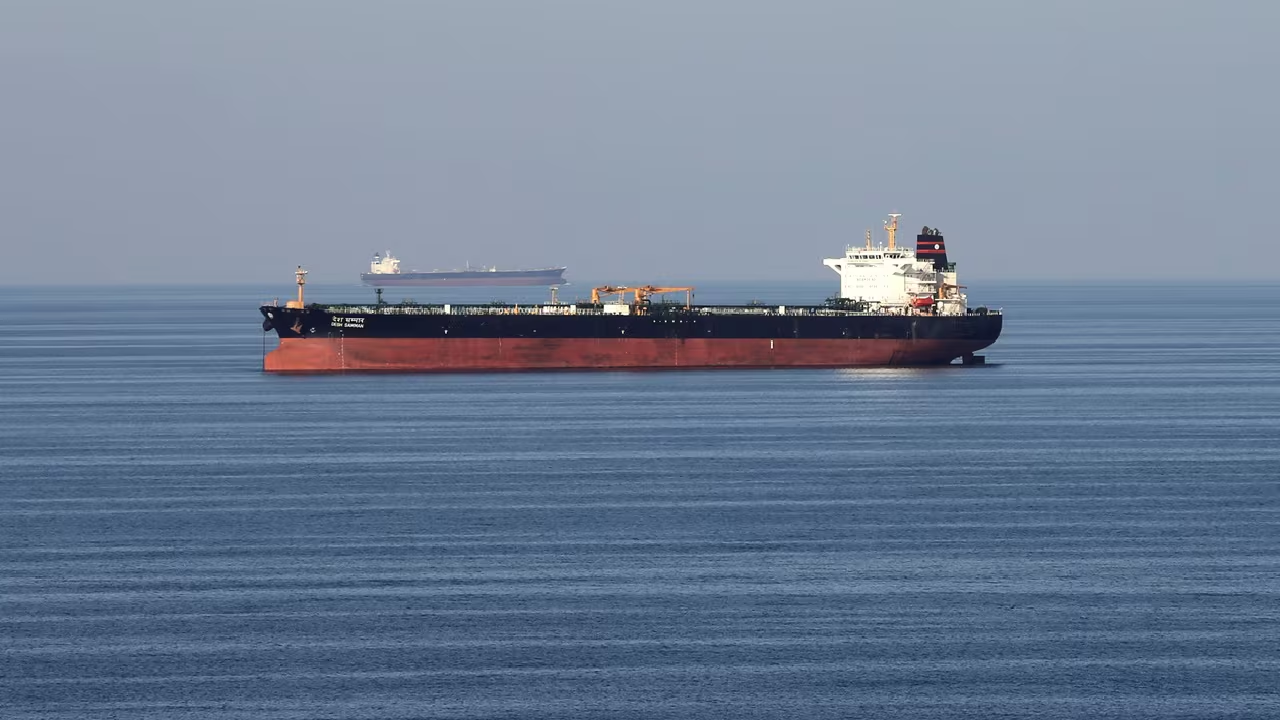
The reported threats by Washington to strike Iranian power plants and energy infrastructure mark a significant departure from calibrated ambiguity. These are not peripheral assets. They are central to Iran’s economic endurance and internal stability. Targeting them signals a willingness to impose systemic costs, not merely tactical pressure. Tehran’s counter-threat, closing the Strait of Hormuz is equally consequential. This narrow waterway, often described in deceptively simple geographical terms, is in reality one of the most critical arteries of the global economy. Nearly a fifth of the world’s oil supply passes through it. Any disruption, even partial or temporary, would reverberate across markets, triggering price shocks, destabilizing currencies, and exposing the structural fragility of energy-dependent economies.

The logic driving both sides is neither irrational nor unprecedented. The United States, as a status quo power, seeks to preserve a regional order that aligns with its strategic interests and those of its allies, particularly Israel and key Gulf states. Iran, by contrast, operates as a revisionist power, attempting to break out of strategic encirclement and assert itself as a regional pole of influence. The American approach has long relied on a mix of sanctions, deterrence, and selective coercion to constrain Iran’s capabilities and ambitions. Yet history offers little comfort that such strategies yield stable outcomes. The experience of the Iraq War remains a cautionary tale. The removal of a regime, however justified it may have seemed within the logic of power projection, did not produce a coherent or stable political order. Instead, it unleashed a prolonged period of instability whose consequences continue to shape regional dynamics.
Iran’s strategy, in turn, reflects the asymmetries it confronts. Lacking the conventional military capacity to match the United States, Tehran has invested in what might be described as strategic leverage rather than strategic parity. Its ability to threaten the Strait of Hormuz is emblematic of this approach. It cannot dominate the global system, but it can disrupt it. This capacity for disruption is both its strength and its constraint. A full closure of the Strait would impose significant costs on its adversaries, but it would also invite overwhelming retaliation
and risk alienating key economic partners, including India. Iran’s power, therefore, lies not in executing maximal threats, but in maintaining the credibility of those threats without crossing thresholds that would trigger uncontrollable escalation.
For India, this unfolding crisis is not a distant geopolitical abstraction. It is an immediate and deeply consequential challenge that intersects with its economic stability, strategic autonomy, and global positioning. A substantial portion of India’s crude oil imports passes through the Strait of Hormuz. Any disruption in this corridor would have direct and immediate consequences for inflation, fiscal balances, and growth trajectories. The vulnerability is not merely economic. It is structural. Geography imposes constraints that no amount of diplomatic maneuvering can entirely eliminate.
Beyond energy, India’s stakes are also human and strategic. Millions of Indian expatriates reside in the Gulf, forming a critical economic bridge through remittances. Their security and well-being are directly tied to regional stability. Any escalation that destabilizes host countries would have cascading effects, both socially and economically. At the same time, India’s strategic investments in the region, most notably the development of connectivity projects, are at risk of being undermined by heightened tensions between Washington and Tehran. These projects are not merely economic ventures; they are integral to India’s broader vision of regional connectivity and strategic access.
In this context, the recent parliamentary articulation by Narendra Modi assumes particular significance. His emphasis on restraint, dialogue, and respect for sovereignty reflects a calibrated attempt to navigate a deeply polarized environment without compromising India’s core interests. This is not the language of indecision. It is the language of strategic prudence. India today maintains a complex web of relationships that defy binary classification. Its partnership with the United States has deepened significantly, encompassing defense cooperation, technological collaboration, and shared concerns about the rise of China. Simultaneously, its engagement with Iran remains rooted in historical ties, energy considerations, and strategic geography. To privilege one relationship at the expense of the other would be to undermine the very logic of India’s foreign policy.
There is, in moments such as this, a powerful temptation to reduce complex geopolitical realities into moral binaries. The United States is cast as an aggressor or as a guarantor of order; Iran is portrayed either as a destabilizing force or as a victim of external coercion. These narratives, while politically resonant, are analytically limiting. Both states operate within a system defined by competition, insecurity, and the absence of overarching authority. Their actions, however contested, are rooted in strategic calculations rather than moral abstractions. For India, the challenge is to resist the allure of such binaries. A foreign policy grounded in moral posturing, however appealing it may be domestically, risks obscuring the material realities that must guide decision-making.
Recent history offers sobering lessons in this regard. The trajectories of Iraq and Libya illustrate the consequences of interventions that dismantle regimes without constructing viable alternatives. The ongoing conflict in Ukraine highlights the perils faced by states
situated at the intersection of competing power blocs. Strategic ambiguity, in such contexts, can prove costly. At the same time, the case of North Korea underscores a different, if deeply controversial, lesson: that in an anarchic international system, the possession of credible deterrent capabilities can ensure regime survival, even in the face of sustained external pressure. These examples do not offer a uniform prescription, but they do converge on a central insight: security, in the contemporary world, is contingent, uneven, and often brutally negotiated.
It is within this landscape that India’s doctrine of multi-alignment must be understood. Too often dismissed as opportunistic hedging, multi-alignment is, in reality, a strategic response to a world in which power is diffuse and alignments are fluid. It is an attempt to maximize autonomy by engaging multiple centers of power without becoming dependent on any single one. This approach demands a high degree of diplomatic agility. It requires the capacity to sustain relationships that may themselves be in tension with one another. It also requires a clear-eyed assessment of national interests, unencumbered by ideological rigidity.
The current crisis tests the limits of this approach. As tensions escalate, the pressure to choose sides is likely to intensify. The United States, as a strategic partner, may expect greater alignment. Iran, as a longstanding partner, may seek reassurance of continued engagement. Navigating these competing expectations will require not only diplomatic finesse but also a willingness to absorb short-term costs in order to preserve long-term autonomy.
At a practical level, India’s response must move beyond declaratory policy and translate into concrete action. Energy diversification is no longer a matter of long-term planning; it is an immediate strategic imperative. Expanding strategic reserves, securing alternative supply routes, and accelerating the transition to renewable energy are essential steps in reducing vulnerability. Diplomatic engagement must also be intensified. India is uniquely positioned to serve as a bridge between competing actors, leveraging its relationships to advocate for de-escalation. This role, however, must be exercised with caution. Mediation is as much about credibility as it is about capability.
Equally important is the need for robust contingency planning. The possibility of disruptions in shipping lanes, sudden spikes in energy prices, or the need for large-scale evacuation of expatriates cannot be dismissed as remote scenarios. They must be anticipated and prepared for with the seriousness they demand. This includes coordination across government agencies, engagement with private sector stakeholders, and the development of rapid response mechanisms.
Yet even the most comprehensive set of policy measures cannot fully insulate India from the structural realities of the international system. Geography, interdependence, and the distribution of power impose constraints that no state can entirely escape. The Strait of Hormuz will remain a critical chokepoint. West Asia will continue to be a region of strategic contestation. The challenge, therefore, is not to eliminate vulnerability, but to manage it in a way that minimizes risk while preserving flexibility.
What ultimately distinguishes effective statecraft in such an environment is not the absence of dilemmas, but the capacity to navigate them without succumbing to either paralysis or overreach. India’s foreign policy tradition, often described in terms of strategic autonomy, is being tested in precisely this manner. Autonomy, in this sense, is not a static condition. It is an ongoing process of negotiation, adaptation, and recalibration. It requires the ability to engage with multiple actors, to balance competing interests, and to make difficult choices under conditions of uncertainty.
The unfolding confrontation between the United States and Iran is unlikely to produce a decisive resolution. More plausibly, it will persist as a pattern of intermittent escalation and cautious de-escalation, shaped by shifting calculations on both sides. The risks of miscalculation, however, remain significant. In such a context, India’s objective cannot be to influence the trajectory of the conflict in any direct or decisive manner. Its objective must be more modest, but no less critical: to safeguard its interests, preserve its autonomy, and maintain its capacity to act independently in a rapidly changing world.
This requires a certain intellectual discipline, a willingness to see the world as it is, rather than as one might wish it to be. It requires a recognition that power, not sentiment, ultimately shapes outcomes in the international system. But it also requires an understanding that power is not exercised in a vacuum. It is mediated by institutions, constrained by interdependence, and shaped by perceptions.
Finally, the crisis in West Asia is not simply a test of regional stability. It is a test of how states navigate a world in which certainty is elusive and risks are magnified. For India, the path forward lies not in choosing sides, but in maintaining the capacity to engage with all sides while remaining anchored in its own interests. This is neither an easy nor a comfortable position. It demands patience, resilience, and a willingness to accept ambiguity.
But it is, under present circumstances, the only viable path. In an era defined by fragmentation and flux, the measure of a state’s success is not its ability to impose order, but its capacity to endure disorder without losing coherence. India’s challenge is to do precisely that: to remain steady in a world that is anything but.
Prime Minister of India on Iran Us conflict :
De-escalation
About the Author