Peerzada Muneer
Holi arrives each year like a sudden burst of light after a long tunnel, a day when streets that were grey the previous week are drenched in pinks, yellows, blues, and greens, and strangers call each other “friend” for a few hours of playful anarchy. It is easy, especially for those watching from afar, to mistake Holi for a mere spectacle of colour and exuberance. In truth, this ancient festival is a carefully layered cultural palimpsest: an inheritance of myth and scripture, an agricultural rite of spring, a meditation on love and morality, and, increasingly, a fragile experiment in equality and reconciliation. Holi is one of the few occasions on which a society as stratified as India’s attempts, even if only temporarily, to suspend many of its visible hierarchies and to imagine a different way of being together.
The very word “Holi” speaks of this desire to pass through fire into renewal. Philologists often connect it with “Holika,” the name of the demoness whose burning is central to one of the festival’s foundational myths, and with “hola,” linked to seasonal offerings of grain to the gods as winter recedes and harvest draws near. In many regions, the festival is called Vasantotsava, the celebration of spring, or Madanotsava, the festival of Kama or Madana, the god of love, words which underline Holi’s deep association with fertility, renewal, and the stirring of desire in both human communities and the natural world. These names remind us that Holi is not only about coloured powder and laughter; it is also about the cyclical burning away of the old so that life—green shoots in the fields, fragile trust in human hearts—can begin again.
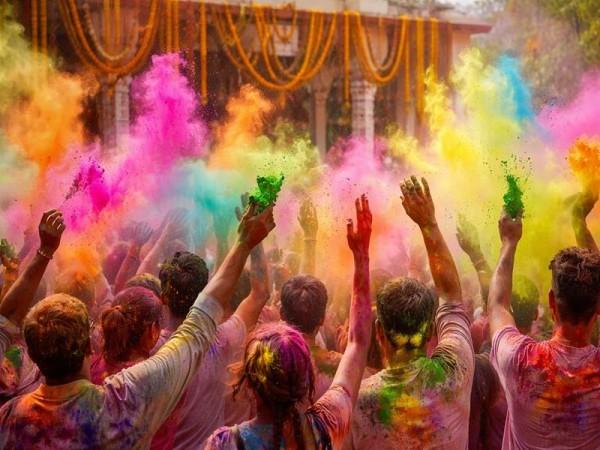
Historically, Holi sits within a broader family of spring festivals that human cultures across the world have marked around the time of the March equinox, when day and night stand almost equal and people sense, in the balance of light and darkness, an opening for new beginnings. In India, textual references to spring celebrations appear in Sanskrit drama, poetry, and ritual manuals under names such as Vasantotsava and Madanamahotsava, and they often describe streets filled with music, flirting, intoxication, and a teasing defiance of social restraint. Over centuries, these seasonal celebrations converged with specific mythological narratives, especially the stories of Prahlada and Holika and of Radha and Krishna, to yield the modern Holi: a festival that fuses agricultural gratitude, social play, erotic energy, and theological reflection into a single, unruly ritual frame.
Scripturally and mythologically, Holi is anchored above all in the story of the demon-king Hiranyakashipu, his devout son Prahlada, and his sister Holika, a narrative that dramatizes the triumph of steadfast faith over tyrannical power. Hiranyakashipu demands that all worship him alone, yet Prahlada refuses, remaining devoted to Vishnu despite repeated attempts on his life. Holika, believed to be immune to fire by virtue of a boon, sits with Prahlada on her lap in a blazing pyre, expecting him to burn while she remains unharmed; instead, the fire consumes Holika and leaves the boy untouched. On the night before Holi, communities gather around bonfires known as Holika Dahan, an act that does not merely commemorate this myth but symbolically burns arrogance, cruelty, and the subtle violences of everyday life, clearing moral space for the colours and laughter of the following day.
In some retellings of the myth, Holika herself is cast not as a villain but as a devotee of Vishnu, and the festival is seen as honouring her; in others, the emphasis falls on Vishnu’s later appearance in the fierce form of Narasimha, the man-lion who slays Hiranyakashipu and restores cosmic order. Such variations matter because they show Holi as a living tradition, not a frozen script. The core, however, remains remarkably stable: Holi insists that power without righteousness is ultimately self-consuming, and that a single child’s unshakeable devotion can outlast the fire of an empire.
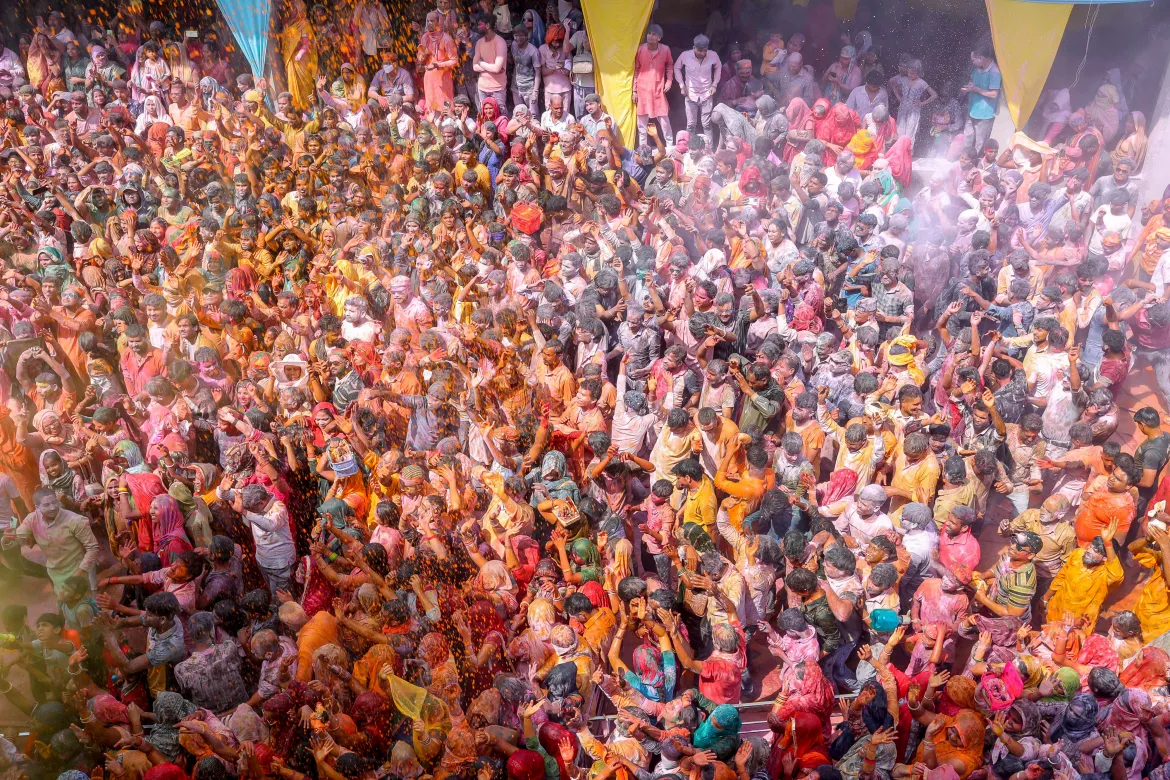
The second great narrative axis of Holi is the pastoral love-play of Radha and Krishna in the Braj region of north India, a mythology that gives the festival much of its distinctive colour and emotional texture. As legend has it, Krishna, dark blue from having drunk poisoned milk in his infancy, worries that the fair-skinned Radha might find him less beautiful; his foster mother Yashoda tells him to colour Radha’s face as he pleases, and he does so, inaugurating the playful exchanges of gulal that are now synonymous with Holi. In this story, colour becomes a medium of intimacy and reassurance, dissolving differences of complexion, status, and ego into shared laughter. In Braj’s towns, Mathura, Vrindavan, Barsana, the festival unfolds over many days in processions, songs, and ritualized mock-battles, with women often taking centre stage in games that symbolically invert gendered power, a reminder that love here is not docile but assertive and teasing.
Other mythic strands weave themselves into Holi’s tapestry: some traditions connect the bonfire with Shiva burning Kama, the god of desire, to ashes after he shoots his arrow at the ascetic god; in Tamil regions this was once celebrated as Kamadahanam, and while those forms have faded there, northern Holi still bears traces of this association in its flames and its frank acknowledgment of erotic energy. Holi thus sits at the meeting point of several mythological arcs: the bhakti of Prahlada, the lila, the playful divine sport, of Krishna, and the dangerous power of desire as both threat and generative force. Each myth offers a different answer to the question of what, exactly, the festival is celebrating: devotion, freedom, love, or the fragile artistry of holding all three together.
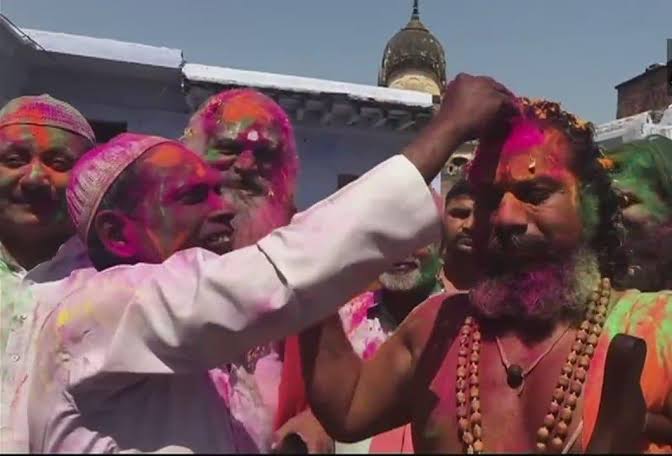
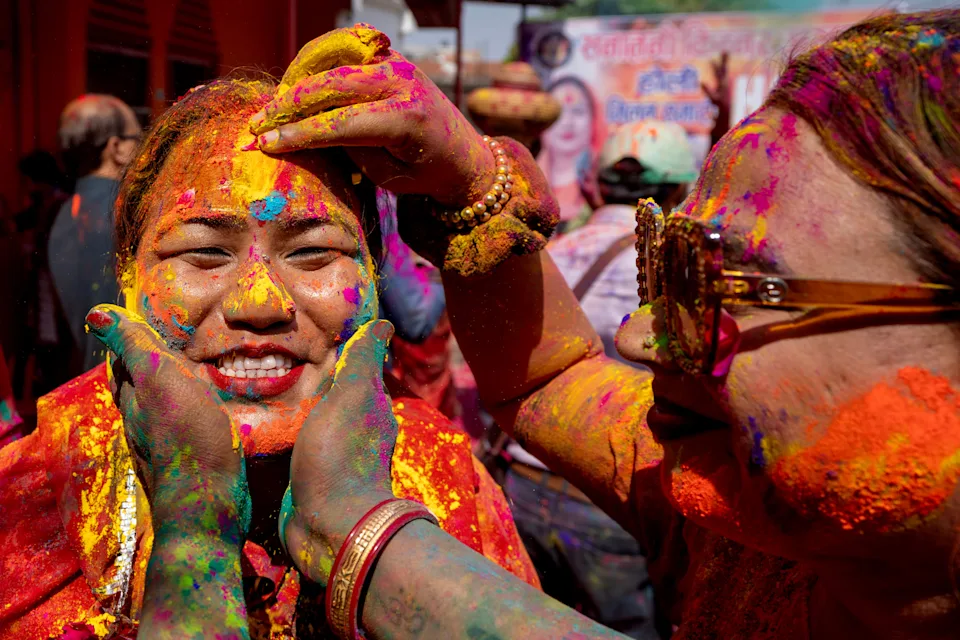
Religiously, Holi is a profoundly symbolic drama of purification and re-creation. The sequence from Holika Dahan to Rangwali Holi is crucial: first the fire, then the colours. Fire, in Hindu ritual, is both destroyer and purifier; circles around the Holika bonfire, offerings of new grain or sweets, and prayers for protection dramatize a willingness to let go of grudges, ego, and the “old story” one carries about oneself and others. The next morning, the streets erupt into what looks like chaos but is in fact a structured release: people smear one another with powders whose hues map an interior palette of emotions, red for love and fertility, yellow for auspiciousness and turmeric’s protective power, green for renewal, blue for the divine, pink for delight. To be drenched in colour by neighbours, elders, or even strangers is to experience, in the body, a kind of ritual levelling: for a few hours, everyone is equally ridiculous, equally transformed, equally visible and yet unrecognizable beneath the pigments.
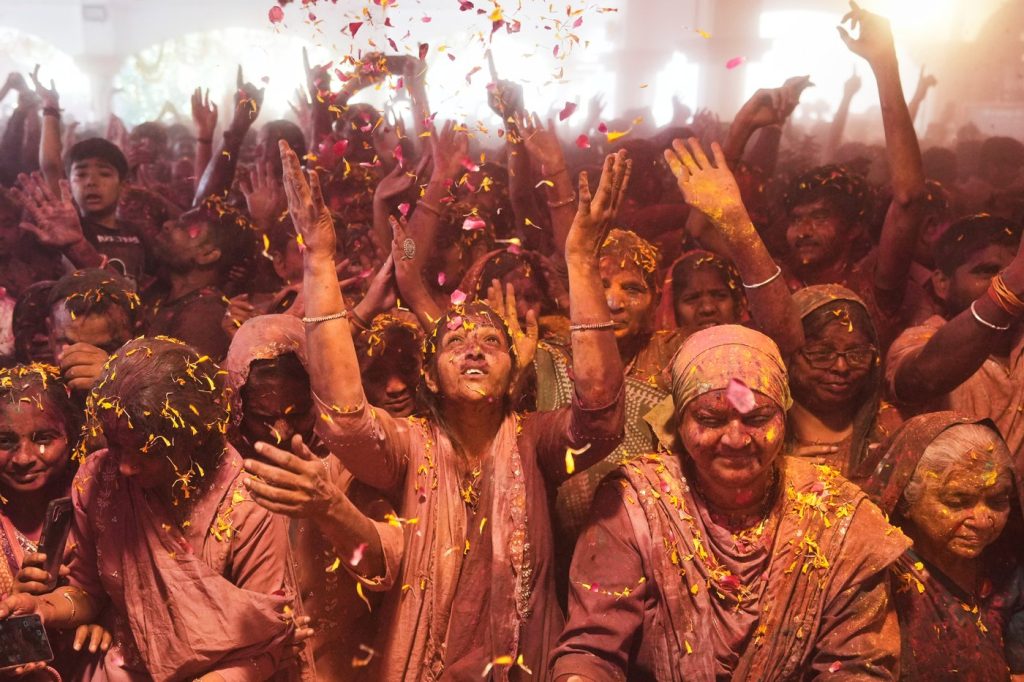
Traditional practice uses natural dyes made from flowers like tesu and marigold, turmeric, sandalwood, and herbal leaves, an eco-friendly heritage that acknowledged the sensitivity of skin and water long before the language of sustainability entered policy documents. In contemporary celebrations, synthetic powders have often replaced these gentler substances, prompting a new discourse on “eco-friendly Holi” and a return to herbal colours. Alongside such material shifts, the social and spiritual layers of the festival persist. “Bura na mano, Holi hai”, do not take offence, it is Holi, is a phrase heard everywhere, a cultural permission slip to prank, tease, approach those to whom one has been distant, or even to apologise indirectly through playful gestures rather than heavy words. Underneath the laughter lies a serious ethic: life together is impossible without some ritual mechanism for forgiveness and for rebalancing relationships.
Over time, Holi has undergone significant evolution in both form and meaning, moving from a largely local, agrarian ritual into an urban, national, and even global event. In pre-modern villages, Holi was embedded in the agricultural calendar, marking the end of winter’s hardship and the anticipation of harvest; the festival acted as an outlet for tensions, a time when the poor could mock their landlords in song, women could improvise sharp verses at the expense of male relatives, and youths could test boundaries in relatively safe ways. In the colonial and early nationalist period of the twentieth century, Holi took on new overtones as political leaders and activists used its imagery of burning evil and overthrowing tyrants to symbolise resistance to British rule. Processions in cities like Kanpur grew longer and more assertive; bonfires and gatherings became opportunities for speeches about freedom and for the forging of horizontal solidarities among the urban poor.
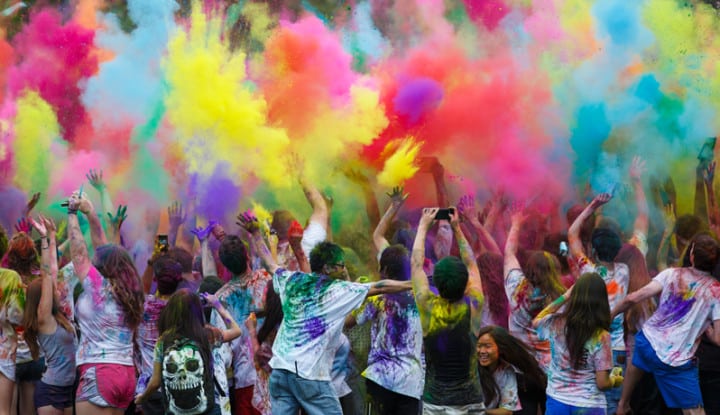
In the late twentieth and early twenty-first centuries, Holi has travelled still further. Diaspora communities in the United States, Europe, and elsewhere organise “Festival of Colours” events, some explicitly religious and others largely secular, drawing participants from many faiths who are attracted by the promise of joy and shared play. Commercial organisers in Indian metros and global cities sell ticketed “Holi parties” with DJs, branded organic gulal, and social-media-ready photo booths, transforming aspects of the festival into lifestyle products. Meanwhile, in different corners of India, regional variations remain rich: Lathmar Holi in Barsana and Nandgaon, Hola Mohalla among Sikhs in Punjab, Dol Jatra in Bengal, and special processions in temple towns like Vrindavan express local histories and theologies through distinct rituals, songs, and performative reversals of gender and rank. Holi, in short, is both more global and more heterogeneous than ever, a reminder that traditions survive by adapting rather than by standing still.
Yet this evolution has not been without tension. Anthropologists and observers have noted that the same festival which in one context loosens hierarchies can, in another, reinforce them. In some villages, Dalits and women bear the bulk of the labour required to stage Holi, preparing fuel, cleaning, cooking, while being excluded from the most exuberant parts of the play or subjected to harassment under the cover of sanctioned “mischief.” Elsewhere, drunkenness and the anonymity of colour have provided cover for violence, molestation, and communal provocation, to the point where police in certain districts issue pre-emptive warnings before Holi and where feminist and Dalit activists describe some celebrations as “unholy” in their impact. These critiques do not negate Holi’s ideals; rather, they sharpen the ethical demand implicit in the myths: if the festival claims to celebrate the victory of good over evil, then those who participate must wrestle with what “evil” looks like in their own time, structural oppression, gendered harm, environmental damage, and how their practice might either perpetuate or resist it.
At its most aspirational, Holi is a social thought-experiment in equality, a carefully timed carnival in which regular social roles are temporarily reversed or blurred. On the full-moon day of Phalguna, normative distinctions of caste, class, gender, and age are, in principle, relaxed: anyone can throw colour on anyone; elders tolerate pranks from children; women in some regions strike men with playful blows in scripted games; servants can mock masters in song without fear of retribution. The sociologist McKim Marriott describes Holi in a Braj village as a moment when “each person plays the role of his opposite”: the servile wife acts the commanding husband, the menial the master, the enemy the friend, and so on, allowing everyone to rehearse other ways of being and to return to their usual roles with a slightly altered understanding. Even if such reversals are fleeting, they matter, because they carve out spaces in which people experience themselves and others outside the tight scripts of status.
The colours themselves act as a leveller. Where the everyday visual field in India can be read like a social map, who wears what fabric, whose clothes are spotless, who smells of perfume or of toil, Holi overlays this with an egalitarian chaos of pigment. For a few hours, it is hard to tell who is rich or poor, upper caste or lower, employer or employee; what one sees are faces streaked with the same mad palette, teeth flashing through the same layers of pink and green. This does not abolish inequality, but it gestures towards a social imagination in which identity is not destiny, and in which the joy of recognising another’s humanity can momentarily override ingrained suspicion.
In our present “post-truth” age, a time dominated by disinformation, polarised narratives, and a collapsing consensus about what is real, Holi speaks in a surprisingly contemporary register. Its foundational myth pits a ruler who insists on his own divinity and reality, Hiranyakashipu, against a child whose adherence to an unseen truth refuses to bend, even under threat of death. The king’s power enables him to control the public story for a time, to demand that everyone affirm his version of reality; yet the narrative insists that truth is not ultimately a function of volume or coercion, but of alignment with a deeper moral order. In a world where algorithms amplify outrage, where communities are set against one another by carefully crafted rumours, and where the loudest voice often seems to win the day, the Prahlada story offers a counter-imagination: that quiet, persistent fidelity, to fairness, to compassion, to a sense of the sacred in others, matters more than the spectacle of domination.
The bonfire of Holika Dahan, read in this light, is not merely about burning a mythic demoness; it is an invitation to consign to the flames those patterns of perception that reduce neighbours to caricatures or enemies. The following day’s coloured chaos, which makes it difficult to maintain rigid boundaries of “us” and “them,” can become an embodied reminder that human identities are complex, overlapping, and more akin to mixtures of pigment than to sharply separated blocks. When Holi is framed and practised consciously, as a space where hateful speech is renounced, intoxicants are moderated, and genuine apology and reconciliation are encouraged, it can work against the grain of our age’s most destructive tendencies: echo chambers, dehumanising rhetoric, and the transformation of every disagreement into a battlefield.
To humanise Holi is to begin not with abstractions but with concrete lives: a grandmother rising early to soak and grind hibiscus petals for natural colour, humming an old Braj bhajan as she works; migrant workers in a metropolis pooling their limited wages to buy a single packet of gulal and share it, laughing, on the shared roof of a tenement; children in a narrow lane of Srinagar or Kanpur or Delhi painting each other’s faces, their quarrels from the previous week forgotten for a moment under a spray of purple. It is to notice the way neighbours who may not exchange more than curt nods all year suddenly arrive at each other’s doors with plates of gujiya and glasses of thandai, saying “Holi hai” as both explanation and bridge. For many, Holi is the one socially sanctioned occasion on which deep-seated grievances can be approached indirectly: a brother estranged over property might be drawn out into the street by nephews squealing and armed with pichkaris, his face reluctantly splitting into a smile as colour lands on his shirt; a friend long avoided may be approached with a hesitant “Bura na mano,” a touch of powder on the cheek standing in for the harder words “I am sorry.”
In regions that have tasted violence, whether communal, political, or domestic, Holi’s potential as a pacifying ritual is delicate but real. The very fact that the festival is theologically rooted in the defeat of a tyrant and the protection of the vulnerable can be harnessed to emphasise protection rather than triumphalism, hospitality rather than conquest. Interfaith Holi gatherings, in which temples, mosques, gurdwaras, and churches send delegations to common spaces, have already emerged in some Indian cities and diaspora communities; there, colour becomes a symbol not of erasing difference but of celebrating it under a shared sky. The narratives of Krishna and Radha, with their emphasis on playful love that ignores social boundaries, can be read less as permission for harassment and more as a call to cultivate relationships in which joy never overrides consent and dignity.
For Holi to realise this reconciliatory potential, however, it must continually return to its own scriptural and ethical roots. The story of Prahlada warns against absolutising any human authority or ideology, including those that speak in the name of religion or nation; the bonfire is a reminder that deifying leader, community, or identity is a form of idolatry as dangerous as Hiranyakashipu’s. The story of Radha and Krishna asks whether love can be playful without being cruel, intimate without being possessive, and whether, in colouring another’s face, one is also willing to be coloured in turn, to be changed by the encounter rather than simply imposing one’s own hue. These questions cut sharply into our present, in which it is tempting to weaponise festivals as markers of cultural dominance rather than occasions for shared delight.
In the end, Holi is a paradoxical teacher. It sanctifies disorder for a day so that a deeper order might be restored; it glorifies colour yet points to what lies beyond all colours, the unmarked space in which a child sits in a fire and does not burn. It makes room for intoxication while warning, through its myths and modern critiques, of how easily joy curdles into harm if not guided by attention and care. It affirms that societies need rituals in which people can act out conflicts, desires, and grievances in safer, symbolic forms, lest those energies erupt elsewhere in more destructive ways. And it suggests that in an age saturated with images and slogans, the slow work of preparing a bonfire, of grinding flowers into powder, of visiting a neighbour’s courtyard with sweets, still has power to reshape how we see one another.
To stand in the midst of Holi is to inhabit, briefly, a different moral weather. Colours hang thick in the air; the familiar outlines of buildings blur; the friend and the stranger approach looking equally absurd and equally beautiful. In that moment, the stories of Prahlada and Holika, of Radha and Krishna, of spring’s age-old return, and of countless unnamed men and women who have carried this festival through centuries, all converge. Holi asks a disarming set of questions: What in you needs to be burnt, and what preserved? Whose face have you not really seen, and might colour help you see it anew? How might a day of sanctioned foolishness make you, paradoxically, wiser? In a time when truth is often treated as just another weapon in partisan battle, this festival of colours proposes a gentler, more demanding vision: that goodness is not loud but luminous, that joy is most authentic when it includes the least powerful, and that sometimes, to remember who we really are, we must first let ourselves be covered, head to toe, in borrowed colours.
On the last evening of Holi, as people wash the final streaks of pink from their hair and sweep multicoloured dust from their thresholds, the world looks, for a brief moment, strangely ordinary and yet newly possible. The festival ends, but its challenge remains: to carry something of that temporary egalitarian utopia into the ordinary days that follow, to treat the neighbour as one treats the friend on Holi, reachable, touchable, forgivable, and to keep, beneath the noise of a cynical age, a small but stubborn faith that good, though often quiet and mocked, still has the power to outlast the flames. In that stubbornness, Holi finds its deepest meaning, and offers, across centuries and continents, its most human gift.