Author: Peerzada Muneer
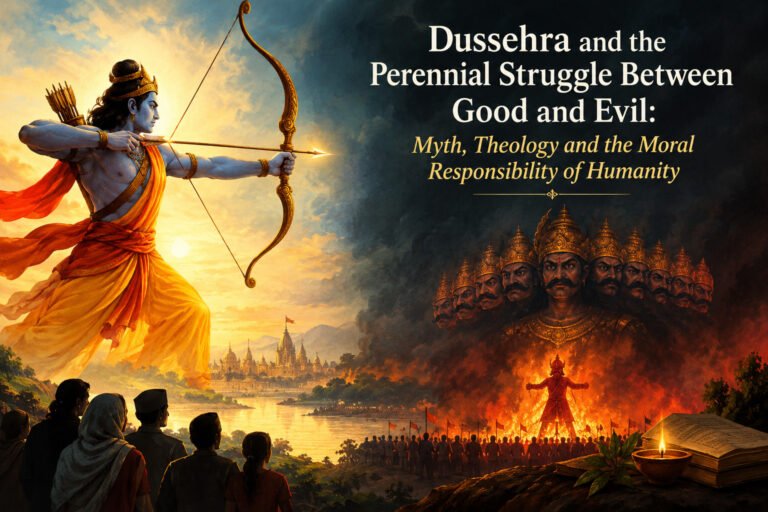
Festivals are among humanity’s oldest attempts to give symbolic form to truths that ordinary language often struggles to express. They transform memory into ritual, mythology into collective experience, and moral reflection into public celebration. Dussehra, also known as Vijayadashami, is one such festival in the Hindu religious and cultural traditions of the Indian subcontinent. Celebrated at the culmination of the Navaratri period, it commemorates the triumph of good over evil, righteousness over injustice, and divine order over forces of disorder. Its significance, however, extends far beyond the familiar images of Ravana’s effigy burning in North India or the worship of the goddess Durga in the eastern and southern parts of the country. Beneath these diverse traditions lies a profound philosophical question that remains as urgent in the contemporary world as it was in the ancient narratives: what does it mean for good to triumph over evil when the forces of evil are not merely external enemies but also dispositions within the human self and structures embedded in society?
The enduring importance of Dussehra lies precisely in its capacity to sustain multiple interpretations without losing its central ethical force. Its narratives are not uniform, its rituals are not identical across regions, and its theological meanings cannot be reduced to a single proposition. Yet these variations illuminate a shared human concern: the struggle to establish a just and meaningful order in a world perpetually vulnerable to arrogance, violence, desire, and the corruption of power.
The Historical and Narrative Worlds of Dussehra
Dussehra emerges from the complex religious world of Hindu traditions, in which epic narratives, Puranic literature, regional devotional practices, and local customs have interacted over centuries. The Sanskrit epic Ramayana, traditionally attributed to Valmiki, provides the most influential narrative framework for Dussehra in much of North India. Its central conflict concerns Rama, the prince of Ayodhya, and Ravana, the king of Lanka, whose abduction of Sita initiates a struggle culminating in Ravana’s defeat. Rama’s victory is conventionally interpreted as the triumph of dharma, a concept encompassing righteousness, duty, moral order, and the obligations appropriate to one’s circumstances and relationships.
The philosophical significance of this narrative lies not simply in the defeat of an antagonist but in the relationship between power and moral legitimacy. Ravana is not portrayed as an ordinary or intellectually insignificant adversary. In many traditions, he possesses formidable knowledge, political authority, military strength, and devotional accomplishments. His downfall therefore suggests that intelligence, learning, spiritual attainment, and power do not independently guarantee wisdom. When these capacities become subordinated to ego, possessiveness, and the refusal to recognise the autonomy and dignity of others, they may become instruments of destruction. Ravana’s tragedy is not that he lacks greatness but that greatness becomes corrupted by his inability to govern himself.
This interpretation invites a more demanding understanding of virtue. Rama’s victory cannot be understood merely as a celebration of one individual’s superiority over another. It raises questions about the responsibilities accompanying authority, the limits of desire, the relationship between personal conduct and public order, and the ethical obligations that persist even in situations of conflict. The epic tradition itself contains tensions and morally difficult episodes, particularly concerning kingship, loyalty, gender, and justice. Such complexities remind us that sacred narratives have historically been sites of reflection and debate rather than merely repositories of uncomplicated moral examples.
In North India, Dussehra is widely associated with Ramlila, dramatic performances of the Rama narrative that bring epic characters into public spaces. These performances vary considerably in form and duration, from elaborate theatrical productions to community enactments and ritual recitations. The burning of Ravana, often accompanied by the destruction of effigies representing Meghnad and Kumbhakarna, turns the epic’s moral conflict into a shared spectacle. The public character of the ritual is significant: righteousness is represented not merely as a private virtue but as a concern of the community. The festival becomes an occasion for collective reaffirmation of ethical ideals, even as its meaning depends on whether those ideals are translated into actual conduct.
The Ramayana tradition, however, is far more diverse than any single regional performance can suggest. As scholars such as A. K. Ramanujan demonstrated in his influential essay Three Hundred Ramayanas, the Rama story exists in numerous literary, oral, theatrical, and devotional versions across South and Southeast Asia. These retellings differ in their characterisation of Rama, Sita, Ravana, and other figures, and they reflect the religious, political, and cultural concerns of the communities that have preserved them. The existence of these traditions complicates any attempt to treat one version as the exclusive or universally accepted expression of the epic. It also demonstrates how a narrative can retain cultural authority while being continually reinterpreted.
The Goddess, the Buffalo Demon, and the Southern Traditions
While the defeat of Ravana dominates many North Indian celebrations, Dussehra in other parts of the subcontinent draws upon a different but related theological narrative: the victory of the goddess Durga over Mahishasura. In the Devi Mahatmya, an influential Sanskrit text embedded in the Markandeya Purana, the gods, unable to overcome the buffalo demon, combine their powers to manifest the goddess. Durga defeats Mahishasura and restores cosmic order. This narrative forms a major theological foundation for Navaratri and Vijayadashami traditions, particularly in eastern India and in many communities across the south.
Here, the symbolism of victory acquires a distinct theological emphasis. The restoration of order does not emerge through the action of a solitary heroic prince but through the manifestation of divine feminine power, or Shakti. The goddess represents the dynamic energy through which existence is sustained and disorder confronted. Her victory challenges interpretations of power that associate authority exclusively with masculine force. It presents divine agency as feminine, creative, protective, and capable of overcoming destructive power when established arrangements fail.
The comparison between Rama’s victory over Ravana and Durga’s victory over Mahishasura is philosophically illuminating. One narrative foregrounds the ethical responsibilities of a prince and the restoration of dharma; the other foregrounds the cosmic efficacy of feminine power in overcoming forces that threaten the order of existence. Their coexistence within the broader Vijayadashami observance suggests that the triumph of good is not exhausted by a single model of heroism. It may require disciplined action, moral courage, collective cooperation, and the awakening of capacities that a society has neglected or suppressed.
In Mysuru, Karnataka, the Dasara celebrations are associated with royal processions, the worship of Chamundeshwari, and the city’s historical relationship with the Wadiyar dynasty. The goddess’s association with Chamundi Hill and the defeat of Mahishasura connect regional identity, devotional practice, and political history. In this setting, the festival has historically communicated ideas about kingship, protection, prosperity, and the legitimacy of public authority. Such traditions demonstrate how religious festivals can function simultaneously as theological observances and as expressions of political culture.
In other southern traditions, Vijayadashami is associated with the beginning of education, the worship of tools and instruments, and the invocation of auspicious beginnings. These practices broaden the meaning of victory beyond military confrontation. Knowledge, skill, artistic accomplishment, and disciplined labour become means through which human beings overcome ignorance and incapacity. Victory is thus understood not only as the destruction of an adversary but also as the cultivation of those abilities that allow individuals and communities to flourish.
The different regional traditions should not be forced into artificial uniformity. Rather, their diversity reveals the interpretive richness of the festival. Whether the central image is Rama, Durga, or the initiation of learning, the underlying concern is the restoration or cultivation of a condition in which human life can be ordered towards meaningful, responsible, and constructive ends.
Sri Lanka and the Ambiguities of the Ravana Narrative
The relationship between Dussehra and Sri Lanka requires particular care, because the island occupies a distinctive place in the geographical imagination of the Ramayana. In the epic, Lanka is Ravana’s kingdom and the setting of the climactic conflict. Yet the cultural history of Sri Lanka cannot be reduced to the role assigned to the island in a narrative transmitted through multiple literary and religious traditions. Nor should the modern political boundaries of Sri Lanka be treated as identical to the mythological geography of ancient texts.
The Ramayana has circulated across South Asia and Southeast Asia through Sanskrit and vernacular literature, performance, visual culture, and religious traditions. Scholarly studies collected in Paula Richman’s Many Ramayanas: The Diversity of a Narrative Tradition in South Asia demonstrate how communities have adapted the story to their own ethical, religious, and cultural worlds. Frank E. Reynolds’s comparative work on the Ramayana, the Buddhist Rama Jataka, and the Thai Ramakien further illustrates the remarkable mobility of the narrative across religious and geographical boundaries. Oxford Bibliographies: Rāmāyaṇa in the Hindu Tradition; Paula Richman, Many Ramayanas.
In contemporary Sri Lanka, Ravana has also become a figure of cultural and historical imagination for some communities and popular movements, where he is sometimes represented as a powerful ruler, a symbol of indigenous heritage, or a figure whose identity deserves reconsideration beyond the conventional antagonist’s role. Such representations are diverse and contested, and their claims about Ravana’s historicity should not be confused with established archaeological or historical evidence. Nevertheless, they reveal something important about the afterlives of epic narratives: characters who embody evil within one interpretive framework may acquire different meanings when a community reconsiders the story through its own cultural memory.
This complication does not invalidate the ethical message associated with Dussehra. Rather, it encourages a more thoughtful engagement with the relationship between moral symbolism and collective identity. When the destruction of Ravana becomes an occasion for humiliating contemporary communities, demonising cultural others, or imagining moral superiority as the exclusive possession of one group, the symbolic act risks contradicting the ethical purpose it claims to affirm. A festival dedicated to overcoming arrogance cannot consistently be interpreted through arrogance towards others.
The philosophical task, therefore, is not to erase the distinctions between competing interpretations but to approach them with historical awareness and moral seriousness. One can participate in the religious meaning of Rama’s victory while acknowledging that the story has generated different cultural memories. Indeed, a mature understanding of tradition does not require intellectual uniformity. It requires the capacity to distinguish devotion from historical simplification, moral conviction from cultural contempt, and the defence of one’s beliefs from the denial of another person’s dignity.

Theological Significance: Dharma, Shakti and the Transformation of the Self
The theological importance of Dussehra becomes clearer when its narratives are read as accounts of the restoration of cosmic and moral order. In Hindu thought, dharma cannot be adequately translated as a single English term. Depending on context, it encompasses duty, righteousness, sustaining order, ethical conduct, and the responsibilities that make individual and collective life possible. The victory of Rama is therefore not merely a victory of one combatant over another; it symbolises the reassertion of an order threatened by the misuse of power and the violation of moral obligations.
Yet dharma also resists simplistic interpretation. The epic tradition places its characters within difficult circumstances in which obligations can conflict and ethical decisions may carry painful consequences. The philosophical value of the Ramayana lies partly in its invitation to reflect upon these tensions. What does righteousness demand when personal loyalty conflicts with public responsibility? How should power be exercised when those subject to it are vulnerable? Can a ruler claim legitimacy without accountability? Such questions make the epic relevant to moral and political philosophy far beyond the religious communities in which it originated.
The goddess tradition adds another dimension. In the Devi Mahatmya, Durga’s victory over Mahishasura establishes the protective and transformative significance of Shakti. As scholar Raj Balkaran explains in his introduction to the text, the Devi Mahatmya portrays the goddess as a supreme power who manifests to protect the gods and restore cosmic order when destructive forces threaten existence. Raj Balkaran, “Devī Māhātmya,” Oxford Bibliographies in Hinduism. The theological implication is that the resources needed to overcome disorder may emerge from powers that have not been adequately recognised within existing arrangements. Read in contemporary terms, this offers a compelling reminder that societies cannot overcome injustice while marginalising the capacities, experiences, and leadership of women.
The two narratives thus provide complementary theological visions. Rama’s story emphasises righteous action and the obligations of power; Durga’s story emphasises the awakening of transformative power against destructive domination. Together, they suggest that moral renewal requires both the discipline to govern oneself and the courage to confront forces that diminish life.
The most demanding interpretation of Dussehra, however, begins when the battlefield is relocated from mythology to the human conscience. The Ravana within the self may take the form of vanity, envy, uncontrolled desire, resentment, dishonesty, or the insistence that one’s own interests must always prevail. These dispositions rarely announce themselves as evil. They often arrive disguised as entitlement, wounded pride, ambition, or the conviction that personal success justifies any means. The individual may condemn injustice in public while practising cruelty in private, praise truth while manipulating facts, and celebrate righteousness while refusing to acknowledge personal wrongdoing.
The burning of an effigy is therefore a powerful symbol, but it is not itself moral transformation. If the effigy burns while the disposition it represents remains untouched, the ritual has completed its external movement without fulfilling its deepest inward possibility. The essential question is not whether Ravana is set alight in a public square, but whether a person is prepared to recognise and confront the forces within that make exploitation, humiliation, and injustice possible.
Such a struggle begins with self-knowledge. One must learn to examine motives honestly, distinguish conviction from prejudice, and recognise the difference between possessing power and deserving trust. It requires restraint, but restraint does not mean passivity. It means refusing to allow anger to determine every response, refusing to let desire abolish ethical limits, and refusing to confuse victory over another person with mastery over oneself. Moral courage is not the absence of temptation; it is the ability to resist the temptation to become what one claims to oppose.
From Personal Virtue to Social Justice: The Contemporary Relevance of Dussehra
The message of Dussehra becomes incomplete if the struggle against evil is confined to individual morality. Human beings do not live in isolation, and the consequences of their choices are shaped by institutions, social hierarchies, economic arrangements, and political systems. Injustice persists not only because individuals possess harmful intentions but also because societies sometimes normalise exploitation, reward dishonesty, and organise power in ways that protect the privileged while silencing the vulnerable. Evil, in this sense, is not always a monstrous individual standing against an otherwise righteous world. It may become an ordinary feature of institutional life, sustained by indifference, conformity, fear, and the collective decision not to intervene.
A contemporary reading of Dussehra must therefore ask what it means to defeat Ravana in a world marked by corruption, gender-based violence, discrimination, communal hatred, environmental destruction, and the systematic humiliation of the weak. What is the meaning of celebrating righteousness when public institutions fail to deliver justice? What does the triumph of good signify when truth is subordinated to propaganda, knowledge is manipulated for personal gain, and human dignity is treated as conditional upon identity, status, or economic worth?
These questions are not accusations directed at any single society or religious community. They concern the universal human tendency to recognise injustice when it affects oneself while rationalising it when it benefits one’s own group. The contemporary Ravana may be found wherever power becomes immune to accountability, wherever wealth is accumulated through the suffering of others, wherever prejudice is converted into public policy, and wherever people are persuaded that another human being’s pain is unworthy of concern.
The lesson is especially important in an age of digital communication, when misinformation can travel faster than reflection and outrage can become a substitute for moral understanding. The symbolic destruction of an enemy is emotionally satisfying because it offers a visible conclusion to a complex struggle. Social transformation, however, is less theatrical. It requires the patient construction of institutions that protect rights, educational systems that encourage independent thought, public cultures that tolerate disagreement, and economic arrangements that enable people to live with dignity. It requires citizens who resist corruption even when corruption offers personal advantage, officials who exercise authority with restraint, and communities that refuse to allow fear or prejudice to determine the worth of human beings.
The ethical significance of Dussehra is also inseparable from the question of how we treat those whom we regard as adversaries. If the triumph of good is interpreted as permission to dehumanise others, then the moral distinction between righteousness and domination begins to collapse. To oppose injustice is necessary; to assume that one is incapable of injustice because one stands on the supposedly correct side is dangerous. History repeatedly demonstrates that people who believe themselves to be defending virtue can become instruments of cruelty when they abandon self-criticism.
This is where the festival acquires a genuinely philosophical depth. It asks humanity to distinguish the destruction of wrongdoing from the destruction of persons. One must oppose cruelty without becoming cruel, resist hatred without cultivating hatred, and defend justice without surrendering the principles that make justice meaningful. Such an ethic does not demand indifference towards wrongdoing. It demands that resistance itself remain answerable to moral standards.
The environmental crisis offers another compelling interpretation. The destruction of forests, the contamination of rivers, the degradation of land, and the pursuit of unlimited consumption reveal a conflict between immediate gratification and the conditions that sustain life. If dharma is understood as the maintenance of an order in which life can flourish, then ecological responsibility becomes part of its contemporary ethical expression. Humanity cannot plausibly celebrate the victory of cosmic order while undermining the natural systems upon which its own survival depends.
Similarly, the goddess traditions invite reflection upon the treatment of women in contemporary societies. The worship of Durga as a manifestation of supreme power acquires a profound moral contradiction wherever women remain vulnerable to violence, exclusion, coercion, or unequal opportunity. Reverence for feminine divinity should inspire serious reflection upon the dignity, freedom, and agency of actual women. Symbolic worship becomes ethically meaningful when it transforms social attitudes and material conditions.
These interpretations do not require every person to adopt Hindu theological beliefs. The religious significance of Dussehra belongs to its practitioners, but its ethical questions can also enter a wider human conversation. Every civilisation has developed stories, philosophies, and practices through which it confronts the relationship between virtue and vice, power and responsibility, ignorance and knowledge. The particular imagery may differ, but the struggle to prevent human capacities from becoming instruments of human suffering is widely shared.
The Perennial Victory That Must Begin Again
Perhaps the most profound truth contained in Dussehra is that the victory of good is never permanently secured. Evil does not disappear from the world merely because it has been defeated in a story, and human beings do not become virtuous simply because they celebrate virtue. Every generation must rediscover the meaning of righteousness within its own circumstances. Every society must confront the injustices it has inherited, the prejudices it continues to reproduce, and the temptations it has learned to excuse.
This does not diminish the festival’s promise. It makes that promise more meaningful. The recurring ritual reminds humanity that moral renewal is possible, but it also reminds us that renewal requires action. The effigy must be burned again because arrogance returns in new forms, because power repeatedly tests the limits of conscience, and because the struggle between selfishness and responsibility is never concluded once and for all.
There is also a deeper humility in recognising that no individual is entirely free from contradiction. The person who seeks justice must examine personal conduct; the person who speaks of compassion must practise it towards those who offer nothing in return; the person who values truth must remain willing to revise mistaken beliefs. Moral maturity begins when the search for wrongdoing moves beyond the comfortable identification of enemies and becomes an honest examination of the self.
At the social level, the same principle demands that communities and institutions remain capable of correction. A just society is not one that claims to have eliminated evil, but one that develops the courage and mechanisms to recognise wrongdoing, protect those harmed by it, and prevent its recurrence. Its strength lies not in an exaggerated belief in its own purity but in its willingness to subject power to scrutiny and to make justice accessible even to those without influence.
Ultimately, Dussehra invites humanity to understand victory not simply as the moment when an enemy falls, but as the moment when the conditions that made injustice possible begin to change. Its highest message is not that some human beings are permanently righteous while others are irredeemably evil. It is that human beings possess the capacity both to destroy and to restore, to dominate and to protect, to surrender to selfishness and to rise above it.
The fire that consumes Ravana’s effigy can therefore be understood as a question addressed to every conscience: what must cease within us so that something more humane may begin? What habits must be relinquished, what injustices must be confronted, and what responsibilities must be accepted before our celebrations of goodness acquire substance?
If Dussehra is to remain alive beyond its ceremonial observance, its victory must be visible in the honesty of our dealings, the fairness of our institutions, the dignity we extend to strangers, the courage with which we resist injustice, and the restraint with which we exercise power. It must be present in the refusal to exploit the vulnerable, in the willingness to acknowledge our own errors, and in the determination to build a world where differences do not become excuses for hatred.
The deepest triumph of good is not the spectacle of evil burning before a crowd. It is the quiet transformation through which a human being becomes less arrogant, a community becomes less unjust, and a society becomes more capable of protecting life and dignity. That victory is neither confined to one religion nor completed on one day. It is the unfinished moral work of humanity.
The true meaning of Dussehra, therefore, is not merely that evil can be defeated, but that every human being and every generation bears responsibility for ensuring that it is. The fire of Vijayadashami should illuminate not only the figures we condemn but also the choices we make, the structures we sustain, and the humanity we are capable of becoming.
Selected scholarship and sources
Fabio Scialpi, “The Feast of Dasarā in the City of Mysore,” East and West, vol. 36, nos. 1–3 (1986), pp. 105–136. View the journal record.
K. Ramanujan, “Three Hundred Ramayanas: Five Examples and Three Thoughts on Translation,” in Paula Richman, ed., Many Ramayanas: The Diversity of a Narrative Tradition in South Asia (University of California Press, 1991). Read the essay.
Ministry of Tourism, Government of India, “Dussehra: Celebrating the Victory of Good over Evil.” Explore regional traditions.
Paula Richman, ed., Many Ramayanas: The Diversity of a Narrative Tradition in South Asia (University of California Press, 1991). Explore the volume.
Raj Balkaran, “Devī Māhātmya,” Oxford Bibliographies in Hinduism (2022). Read the scholarly overview.
About the Author