Women on the Front Lines.
Written by: Durdana Samoon
The epidemiology of substance abuse rarely emerges in a vacuum. In Jammu & Kashmir, the accelerating prevalence of drug dependency over the past decade is intelligible only when read against the region’s layered history — decades of armed conflict, interrupted economic development and mass psychological trauma.What has taken root in this environment is not merely a public health crisis but what sociologists would recognise as a social pathology: a symptom of structural disintegration rather than individual moral failure (Merton, 1938; Young, 1999).
The statistics are stark. Government data indicates that the Nasha Mukt Bharat Abhiyan (NMBA) — launched nationally in 2020 — has reached more than 98 lakh people in Jammu & Kashmir, including over 9 lakh women, making them one of the largest engaged constituencies within the initiative. Over 31,000 individuals have been treated for drug de-addiction in the past two years under various institutional mechanisms, including rehabilitation centres and treatment facilities. Yet aggregate figures, however impressive, can obscure as much as they reveal. The more analytically significant story lies not in the numbers but in who is doing the work of outreach, detection, and recovery — and what that tells us about the structural logics of welfare governance in conflict impacted societies.
That question has acquired renewed urgency in April 2026, with the launch of a structured 100-day intensive campaign under the Nasha Mukt Jammu Kashmir Abhiyaan. Lieutenant Governor Manoj Sinha chaired a high-level meeting to review preparations for the campaign, flagging off a mega padyatra from Jammu on 11 April, with a follow-up launch planned for Srinagar in May. J&k LG M. Sinha characterised the drug influx into the Union Territory as part of a larger international conspiracy to jeopardise the future of the youth, a framing that explicitly links the anti-narcotics effort to questions of geopolitical security as well as public health.
On 24 April, Sinha launched the ‘Drug-Free J&K Campaign’ in Reasi and called for a sustained, society-wide movement to eliminate narcotics, stressing that the campaign must evolve into a historic movement rooted in homes, schools, mohallas and villages, driven by open and honest dialogue. The rhetorical register of these statements is significant: the LG consistently appeals not to enforcement alone but to jan bhagidari — people’s participation — as the campaign’s animating principle.
It is within this context that the centrality of women becomes most clearly legible. Since the campaign’s launch on 11 April, 1,947 women committees have been established across districts in the Jammu division. Sinha observed that with the support of mothers and sisters, this cancer in society will be cured, calling upon them to build a historic movement that rises from homes, schools, mohallas, and communities, and begins with open, honest dialogue in towns and villages.
The Lieutenant Governor’s language — positioning women as the moral bedrock of the anti-drug effort — is more than rhetoric. It reveals a governing logic that, whether consciously or not, delegates the labour of social repair to women while framing that delegation as an honour rather than a burden.
Against this backdrop, the Government of India’s Nasha Mukt Bharat Abhiyan has operated in Jammu & Kashmir as something more than a bureaucratic initiative. It has become a lens through which to examine an older and more fundamental question: who does the work of social repair, and at what cost? Women constitute approximately 7% of drug users in the region — around 62,000 individuals — yet face far greater stigma and barriers to treatment than their male counterparts. The paradox that defines NMBA’s trajectory in J&K is this: the group most structurally disadvantaged within the addiction ecosystem has simultaneously become its most active rehabilitative force.
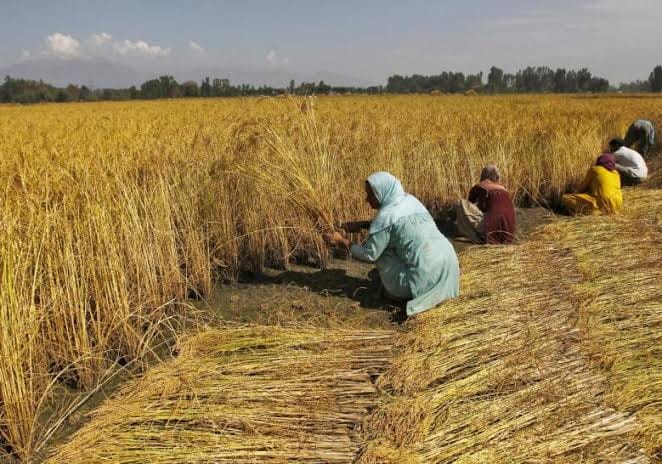
To account for this paradox, one must draw on sociological frameworks that go beyond policy mechanics. Idea of “conscience collective”, given by Emile Durkheim which is the shared moral order that holds a society together, is one way to look at this (Durkheim, 1893). For Durkheim, the state alone does not keep social cohesion; it is also created through the moral work of families and communities every day. In Jammu & Kashmir, as in many traditional societies, that labour falls disproportionately on women. What NMBA has done, whether by design or by default, is to instrumentalise this pre-existing social architecture. Women-led Self-Help Groups (SHGs), Anganwadi workers, and ASHA health workers have become the first line of defence against substance abuse, with their embeddedness in local communities enabling them to identify early warning signs — behavioural changes, withdrawal patterns, or financial distress — often before formal institutions can intervene.
This is not simply a story of efficient delivery mechanisms. It generates deeper questions about the gendering of care work in public policy. When states rely on women’s unpaid or underpaid community labour to deliver welfare outcomes, they are simultaneously affirming and reproducing an unequal division of social reproduction (Fraser, 1994). The integration of women into public programmes often extends their caregiving responsibilities rather than redistributing them — a tension that sits unresolved at the heart of NMBA’s convergence model, and which the rapid formation of 1,947 women committees in a matter of days brings into sharp relief.
Reports indicate that even within a traditionally conservative social structure, women have begun leading rehabilitation efforts, including participation in the first women-run de-addiction support spaces in the Valley. These spaces are politically and therapeutically significant for reasons that extend beyond their immediate function.
Addiction in Kashmir, as elsewhere, operates within a moral economy of shame: families conceal dependency, communities ostracise the affected, and women — whether as users or as relatives of users — face a compound stigma that intersects gender with moral failure. Women-led de-addiction environments challenge this economy by reframing addiction as a health condition rather than a character defect — a shift that the medical humanities scholar Arthur Kleinman would describe as a transformation in the explanatory model through which illness is understood and addressed (Kleinman, 1988). In societies where shame operates as a structural barrier to treatment-seeking, the ability to normalise help-seeking behaviour is itself a public health intervention. This reframing is echoed in the official campaign messaging, which explicitly declares that addiction is not a crime but an illness that calls for empathy, care, and support, with the approach focused on prevention, early intervention, and rehabilitation.
Female students in colleges and universities across the region have also actively participated in NMBA campaigns, organising awareness drives, peer counselling sessions, and public discussions. This dimension of the campaign draws, implicitly, on a well-established body of research in behavioural science: that peer-to-peer communication is substantially more effective in shaping youth behaviour than top-down authoritative messaging (Cialdini, 2001; Rogers, 2003). By positioning young women as public advocates rather than passive recipients of anti-drug messaging, NMBA has created a mechanism for simultaneous norm change — one in which gender norms and drug-use norms are being renegotiated in tandem.
At the level of governance, the shift in official discourse visible in the 2026 campaign launch represents a meaningful departure from the historical tendency in Indian welfare policy to treat women as beneficiaries of state intervention rather than as agents of it. Sinha described NGOs, social organisations, educators, and spiritual leaders as frontline guardians capable of mobilising communities and restoring social resilience,a formulation that places civil society — and within it, women — at the centre of the policy’s success rather than its periphery. The campaign aims to provide support to those struggling and to build a healthier, happier society, with the administration emphasising that its success depends on collective efforts and does not belong to any one individual but is about the future of Jammu and Kashmir’s youth. That policymakers are now articulating women’s participation as constitutive of policy success — rather than incidental to it — reflects a more sophisticated understanding of how social change actually occurs (Kabeer, 1994).
Yet acknowledgement is not the same as structural support. Patriarchal norms may continue to restrict mobility and public participation in certain areas. Women involved in anti-drug efforts often face emotional and psychological burdens what sociologists term emotional labour (Hochschild, 1983) particularly when dealing with addiction within their own families. There are also profound gaps in training and institutional support, with many women engaged in grassroots interventions lacking formal counselling skills. The rapid mobilisation of nearly 2,000 women committees in under a fortnight, while operationally impressive, raises legitimate questions about whether the institutional infrastructure for sustained, adequately supported engagement has been built alongside it.
The story of NMBA in Jammu & Kashmir ultimately offers a broader lesson in the political economy of public policy. Institutional frameworks, however well-designed, cannot substitute for social embeddedness. The campaign’s measurable progress in the region is attributable not primarily to its administrative architecture but to its capacity , however uneven — to engage with the social fabric through the medium of women’s community networks. This is, in one sense, a vindication of what the political scientist James Scott described as the limits of high-modernist planning: the recognition that local knowledge, informal networks, and community trust cannot be engineered from above but must be worked with, on their own terms (Scott, 1998).
What remains to be resolved is the distributional question: whether the burdens and rewards of this social labour will be more equitably shared. A genuinely transformative anti-drug policy — one that is not merely effective but also just — would treat women not as instruments of delivery but as rights-bearing citizens whose participation in public health must be matched by reciprocal investment from the state. The campaign may remind society that among the strongest pillars are the rule of law, constitutional values, the ethic of duty, and a spirit of jan bhagidari, as LG Sinha has asserted. But jan bhagidari — people’s participation — is sustainable only when the people doing the participating are supported, recognised, and protected in equal measure. That remains, for now, an aspiration rather than a reality. But it is one that the trajectory of NMBA in Jammu & Kashmir, and the urgency of its April 2026 iteration, makes both visible and pressing.
References
Cialdini, R.B. (2001). Influence: Science and Practice. 4th edn. Boston: Allyn & Bacon.
Durkheim, É. (1893). The Division of Labour in Society. Trans. W.D. Halls. London: Macmillan, 1984.
Fraser, N. (1994). ‘After the Family Wage: Gender Equity and the Welfare State’. Political Theory, 22(4), pp. 591–618.
Greater Kashmir (2026). ‘LG Manoj Sinha Leads Nasha-Mukt J&K Campaign in Reasi’. 24 April. Available at: https://www.greaterkashmir.com [Accessed April 2026].
Hochschild, A.R. (1983). The Managed Heart: Commercialization of Human Feeling. Berkeley: University of California Press.
JK Monitor (2026). ‘Nasha-Mukt J&K Campaign in Reasi: Properties of Drug Smugglers Have Been Demolished’. 24 April. Available at: https://jkmonitor.org [Accessed April 2026].
Kabeer, N. (1994). Reversed Realities: Gender Hierarchies in Development Thought. London: Verso.
Kashmir Observer (2026). ‘Collective Force Has Risen Against Drugs: J&K LG’. 24 April. Available at: https://kashmirobserver.net [Accessed April 2026].
Kleinman, A. (1988). The Illness Narratives: Suffering, Healing, and the Human Condition. New York: Basic Books.
Merton, R.K. (1938). ‘Social Structure and Anomie’. American Sociological Review, 3(5), pp. 672–682.
Nasha Mukt Jammu Kashmir Abhiyaan (2026). Official Campaign Website. Available at: https://www.nashamuktjk.org [Accessed April 2026].
Northlines (2026). ‘Nasha-Mukt Campaign: Sinha Calls for United Fight Against Drug Abuse’. 24 April. Available at: https://thenorthlines.com [Accessed April 2026].
Rogers, E.M. (2003). Diffusion of Innovations. 5th edn. New York: Free Press.
Scott, J.C. (1998). Seeing Like a State: How Certain Schemes to Improve the Human Condition Have Failed. New Haven: Yale University Press.
The Kashmir Monitor (2023). ‘Nasha Mukt J&K: Over 31,000 Treated for Drug De-Addiction in Two Years’. Available at: https://www.thekashmirmonitor.net [Accessed April 2026].
Tribe / Article 14 (2025). ‘From the Brink of Ruin: How Women in J&K Are Fighting a Growing Drug Addiction Epidemic’.
Young, J. (1999). The Exclusive Society: Social Exclusion, Crime and Difference in Late Modernity. London: Sage.
About the Author