Farhat Naaz
For more than three decades, terrorism in Jammu and Kashmir has imposed a human cost that extends far beyond the arithmetic of attacks and casualties. While violence has affected every section of society, women have borne a distinct and disproportionate burden, often quietly and out of sight. Their suffering has unfolded not only through direct acts of terror but through sustained social disruption, gendered violence, economic marginalization, psychological trauma, and the systematic denial of opportunities, including education. In this prolonged conflict, Kashmiri women have emerged as primary victims.
The eruption of militancy in the late 1980s fractured Kashmir’s social order. Targeted killings, assassinations, and intimidation campaigns destabilized families, leaving thousands of women widowed or without male earners. Many were forced into sudden economic responsibility without skills, assets, or institutional support. A particularly cruel outcome was the phenomenon of “half-widows”—women whose husbands disappeared after abductions or militant violence, with no confirmation of death. These women lived for years in legal and emotional limbo, unable to remarry, inherit property, or access welfare schemes, while carrying the psychological weight of unresolved loss.

The targeting of women was evident from the very early phase of militancy. On December 8, 1989, Rubaiya Sayeed, a young medical intern and the daughter of then Union Home Minister Mufti Mohammad Sayeed, was abducted in Srinagar by militants of the Jammu and Kashmir Liberation Front. Kidnapped while returning from hospital duty, she was held for five days before the government released five jailed militants in exchange for her freedom. Though Rubaiya Sayeed was physically unharmed, the incident demonstrated the strategic value of abducting women, legitimised kidnapping as a militant tactic, and emboldened insurgent groups. Security analysts have since widely cited the episode as a turning point that accelerated targeted violence, intimidation, and the use of women as leverage in the conflict.
Prana Ganjoo, wife of Prof. KL Ganjoo, an agro-scientist by training at the Agriculture College in Sopore, also became the victim of terror oppression. In early 1990, K. L. Ganjoo travelled to Nepal on an official assignment. His wife, Prana Ganjoo, and his nephew accompanied him. After completing the assignment, the family returned to Kashmir in March 1990.
As the family entered Sopore, two employees from the Agriculture College arrived in a jeep to receive them. Midway across the Sopore bridge, the vehicle was stopped. Prof. K. L. Ganjoo was pulled out and shot multiple times. His wounded body was thrown into the Jhelum.
The attackers then turned to Prana Ganjoo. Her nephew was confronted with a cruel ultimatum: jump into the river or remain and witness the torture of his aunt. He chose to jump, surviving the current but forced to leave her behind.
Prana Ganjoo was subjected to extreme sexual violence. She was gang-raped, mutilated, and shot. Her breasts were severed and was thrown into the River Jhelum. Prana Ganjoo was not a participant in conflict. She carried no weapon and posed no threat. Her only “crime” was standing beside her husband and returning to a home they believed was still theirs.
As militancy escalated in the early 1990s, the consequences for women became more severe and more widespread. Militant threats, selective killings, and fear-driven campaigns forced nearly the entire community to flee the Valley. They were uprooted from ancestral homes and livelihoods and pushed into refugee camps where living conditions were harsh and insecure. This displacement was accompanied by gendered violence. Survivor testimonies from that period document cases of abduction, rape, and sexual intimidation of women, especially Pandit women—crimes that largely went unreported due to stigma, fear of reprisals, and the absence of effective legal protection.
The abduction, rape, and brutal killing of Girija Tickoo, a young Kashmiri Pandit woman from Bandipora, became emblematic of the gendered brutality that accompanied militant violence and accelerated the community’s exodus. Girija worked as a laboratory assistant/non-teaching staff at a Government Girls High School in Trehgam, Kupwara. Like thousands of Kashmiri Pandits, her family was forced to flee the Valley in early 1990 due to escalating militant threats and violence.
In June 1990, Girija Tickoo returned to Kashmir temporarily to complete service-related formalities. During this visit, she was kidnapped by militants affiliated with the Jammu and Kashmir Liberation Front (JKLF). Credible human-rights documentation and later compilations report that Girja Tickoo was subjected to prolonged sexual violence and torture. She was subsequently brutally killed on 25 June 1990 and became emblematic of the gendered brutality that accompanied militant violence and accelerated the community’s exodus.

Sexual violence, though poorly documented, functioned as a weapon of terror across communities. Women’s bodies were used to intimidate families and assert militant control. The lack of legal action, combined with strong social stigma, meant that most survivors felt unheard, while the trauma endured long after the violence itself.
The case study documents another such incident from Kreeri, Baramulla, illustrating how terrorism weaponizes gendered violence and silences victims. In a village in Kreeri of district Baramulla, militants from Hizbul Mujahideen forcibly used the home of a local 25 years old woman (identity concealed for safety and dignity) as a hideout. The presence of armed militants left her with no agency or choice. During their stay, she was subjected to repeated sexual assault by the militants.
On one occasion, when a group of militants again came to stay at her house, she was ordered to serve them again. Exhausted by prolonged abuse and humiliation, she reacted and resisted. This act in a terrorized environment was a direct challenge to the militants’ authority. The refusal was met with brutal retaliation. The militants attacked her at her bakery shop. In a public act of terror meant to serve as a warning to others, she was killed.
While militant narratives often claim to fight for “justice” or “freedom,” cases like this expose the hypocrisy of such claims and reveal women as some of the most unacknowledged victims of terrorism.
Terrorism also attacked women’s visibility and independence. Sarla Bhat, a 27 years old nurse at Sher-e-Kashmir Institute of Medical Sciences (SKIMS) in Soura, Srinagar stands as one of the most harrowing examples of how terrorism used gendered violence and fear to enforce displacement and silence. was abducted, raped, and monstrously murdered by militants in the 1990s.
On 18 April 1990, at the peak of the insurgency, Sarla Bhat was abducted by militants of the Jammu and Kashmir Liberation Front (JKLF) from the Habba Khatoon Hostel at SKIMS. Five days later, her bullet-riddled body was recovered from Umar Colony, Mallabagh, in downtown Srinagar. Reports indicated that her body bore multiple gunshot wounds and later investigation revealed the brutal sexual assault and mutilation.
Supinder Kour (c. 1975–2021) was the Principal of Government Boys Higher Secondary School, Eidgah, located in downtown Srinagar. A resident of Aloochi Bagh at the time of her death, she had previously served in other government schools in Kashmir. She was known among colleagues and neighbors as a quiet, dedicated educator and was actively involved in charitable work, including financially supporting a Muslim orphan girl from her own salary. She belonged to the Sikh minority community in Kashmir and was a mother of two young children.
On 7 October 2021, around 11:15 a.m., armed militants entered the Government Boys Higher Secondary School in the Sangam/Eidgah area of Srinagar. Although classes were being held online and no students were present, staff members were in attendance. The attackers checked the identity cards of teachers and deliberately singled out Supinder Kour and her colleague Deepak Chand, a Hindu teacher from Jammu. Both were escorted out and shot at close range inside the school premises. Deepak Chand died on the spot, while Supinder Kour succumbed to her injuries while being rushed to hospital. The killings were targeted and selective, based on religious identity and professional role. The terror outfit The Resistance Front (TRF), a Lashkar-e-Taiba affiliate, was identified by authorities as being behind the attack.

In June 2022, a Kashmiri Muslim folk singer Amreena Bhat was shot dead by militants inside her home in Budgam district. Her killing, reportedly linked to her public performances and cultural presence, sent a chilling message across the Valley. Women who stepped into public life as artists, professionals, or cultural figures were reminded of the risks of visibility. The impact was immediate and quiet: many women withdrew from public engagement, reinforcing a climate of fear without the need for constant violence. These cases are not isolated incidents; there are thousands of such cases across Jammu and Kashmir that remain undocumented, unreported, or unresolved.
Beyond such high-profile cases, women were routinely targeted indirectly. Women who were relatives of police personnel, political workers, teachers, and government employees were faced with threats and harassment aimed at coercing or punishing their male family members. Private spaces ceased to be safe, and women were reduced to pressure points in a larger strategy of terror.
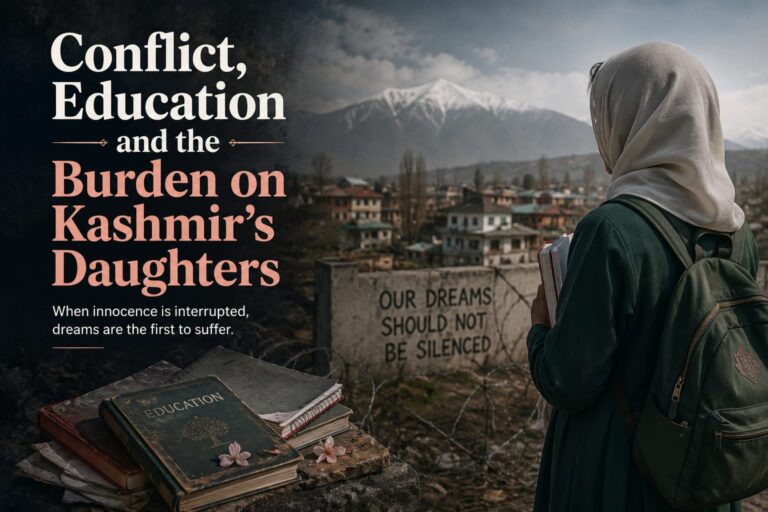
One of the most deleterious yet least acknowledged effects of militancy was the systemic disruption—and at times de facto banning of education, particularly for girls. During the insurgency’s peak years, schools and colleges remained closed regularly because of strikes, boycott calls by militants and separtists, gunfights, and security operations. Educational institutions were attacked, teachers threatened, and students intimidated. In several areas, militant diktats discouraged or outright opposed girls’ education, viewing it as incompatible with their ideological vision. Fear of abduction, harassment, or violence led many families to pull daughters out of school. For an entire generation of Kashmiri girls, education became sporadic, unsafe, or inaccessible, with long-term consequences for employment, economic independence, and social mobility. The loss of education not only foreclosed individual futures; it also helped reinforce cycles of dependency and marginalization for women across decades.
The psychological effects of this entrenched violence have been devastating. Mental health surveys carried out within the theatre of conflict continue to report higher prevalence rates for anxiety, depression, and post-traumatic stress among women—especially among widows, half-widows, and those displaced due to conflict. Constant exposure to fear of gun battles, explosions, abductions, and uncertainty normalized trauma. Limited mental health infrastructure and social stigma ensured that most women suffered in silence, passing unaddressed trauma to the next generation.
The result of terrorism on an economic level was to hollow out women’s livelihoods. As tourism fell away, agriculture was disrupted, and markets became insecure, women-led households were forced into informal, insecure labour. More traditional forms of income generation, for example, handicrafts and embroidery, declined amidst ongoing curfews and mobility restrictions. Poverty further reduced women’s autonomy, reinforcing dependence within families and limiting their capacity to recover from loss. They have remained absent from justice mechanisms and peace processes, despite being among those most affected. Very few crimes against them, especially those related to sexual violence and intimidation due to terrorism, result in accountability. Policy responses have remained overwhelmingly security-centric, with abysmally little focus on gendered harm, social rehabilitation, or long-term healing. The women’s experiences remain marginal in the official narrative, even as they bear the heaviest consequences.
Yet throughout the conflict, Kashmiri women have sustained families and communities—raising children alone, caring for the displaced and elderly, preserving cultural memory, holding society together amid collapse. This resilience, however, must not obscure the scale of victimhood. Survival under prolonged violence is not evidence of immunity; it is testimony to endurance imposed by circumstance. These incidents are not isolated. Hundreds of similar cases—ranging from sexual violence, intimidation to murder have occurred in Kashmir over decades of conflict. Many women and girls have never dared to raise their voices, choosing silence as a means of survival.
The story of terrorism in Kashmir would always remain incomplete without bringing to the centre the experiences of women. Everything from the silenced suffering of displaced Kashmiri Pandit women to targeted killings, denied education, and unaddressed trauma demonstrates that this conflict’s gendered impact is both historical and ongoing. The true cost of terrorism in Kashmir would remain underreported as long as these realities remain undocumented, sans justice and inclusion in a practical sense, and therefore its deepest wounds remain unhealed.
This study is based on documented real-life case studies drawn from officially registered First Information Reports (FIRs), contemporaneous media reports, judicial records where available, and credible human-rights documentation. Some names and identifying details have been withheld or anonymized to protect the security, dignity, and integrity of individuals and families.
About the Author