By Farhat Naaz
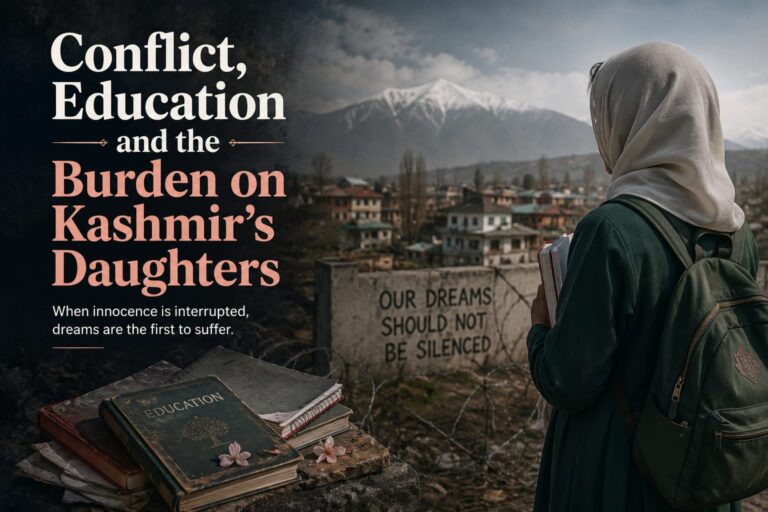
The contemporary landscape of Jammu and Kashmir offers one of the most important case studies in gender transformation in present-day India. The last decade has witnessed a structural and attitudinal revolution in terms of young women’s participation in public domains, academic competition, state-building agencies, employment-generating entrepreneurship, sports, and civic imagination. Historically, Kashmiri women have carried an intergenerational load of socio-cultural constructions that limited their agency and mobility. Patriarchal norms, subtly internalised or openly endorsed, locked potential within domestic boundaries and invisibilised female excellence behind the notion that the “public sphere” was not a space for women. In addition to patriarchy as a social construct, many cultural and pseudo-religious narratives were weaponised to moralise women out of decision-making structures. Traditionally, many civilisational legacies around the world have contained rich records of women scholars, leaders, administrators, and innovators. Yet, in the subcontinent particularly, the gradual distortions of culture over time, shaped by colonial imprint, feudal memory, economic dependency structures and the consolidation of male authority, disconnected many original egalitarian principles from actual lived social practice. The result historically was a society in which girls were compelled to constantly prove their capability rather than simply exercise it as a natural right. In this backdrop, the present data showing young Kashmiri girls not only matching but consistently outperforming boys is therefore far more than an educational statistic, it is an epistemic and structural reversal of a century-old patriarchal architecture.
Over the last ten to twelve years, the classrooms, coaching centres, polytechnics, universities, civil services and sports arenas of Jammu and Kashmir have started displaying a pattern that is no longer anecdotal, it is statistical and structural. The Jammu and Kashmir Board of School Education (JKBOSE) Class 10 annual regular results demonstrate this consistently: in 2023, the overall pass percentage was 79.89% of which 81.68% girls passed compared to 78.23% boys; in 2024 the overall pass percentage was 79.25% of which 81.10% girls cleared the exam compared to 77.33% boys; and in 2025 the overall pass percentage was 79.94% of which 81.24% girls passed compared to 78.74% boys. The pattern is mirrored in Class 12 as well: in 2023 the overall pass percentage was 65% of which girls scored 68% compared to 61% boys; in 2024 the overall figure was 74% of which girls scored 77% compared to 72% boys; and in 2025 the overall figure was 75% of which girls scored 80% compared to boys who achieved only 69%. These are not marginal differences; these are structural trends showing that year after year girls are consistently performing better than boys. This is not common in large parts of India, where regional gender gaps in secondary education remain pronounced. In Jammu and Kashmir therefore, this constitutes not simply a positive shift but a fundamental reframing of aspiration: girls are no longer entering classrooms merely for literacy, they are entering to lead.

The aspirational biographies of several young women illustrate how the narrative has moved away from “access alone” to “leadership as expectation”. The story of Iqra Farooq, the daughter of a tailor from Zakura in Srinagar, who became the second topper in the 2023 Jammu and Kashmir Administrative Service examination, demonstrates how economic constraint is no longer a structural restriction in this emergent generation. Similarly, the case of Afiya Javaid of Kulgam, who secured 8th rank in the JKAS examination in her fourth attempt in 2024, illustrates a crucial psychological shift: women can take multiple attempts, and are not pressured to collapse their aspirations into narrow marriage timelines. The narrative of perseverance among young women in Kashmir today has actually become anti-patriarchal because it dismantles the centuries-old argument that male lineage is the only legitimate carrier of public decision-making. Athletes like the martial arts prodigy Tajamul Islam, who began training at six and emerged as India’s youngest national kickboxing gold medallist from a rural corner of Bandipora, signify a geographical breakthrough, rurality is no longer a disqualification. Taekwondo athlete Afreen Hyder representing India internationally and Nasira Akhter, an innovator from Kulgam who turned polythene waste into eco-ash using herbs, thereby earning the Nari Shakti Puraskar in 2022, are evidences of how female capability is now confidently carving space in STEM, innovation and environment-linked research, areas that were previously coded masculine.
This deepening capacity-building is also visible in the civil services and judiciary. Between 2021 and 2025 women from J&K have been securing high-ranking national and state-level administrative positions. The example of Anmol Rathore from Bhaderwah who secured All India Rank 7 in UPSC Civil Services 2023, the first woman from her area to enter the single-digit rank space, symbolises this breakthrough. In judiciary, the case of Tasneem Kawoos from Srinagar topping the Judicial Services Exam in 2023 is emblematic. And again, in 2024, Iram Choudhary securing AIR 40 in UPSC indicates how this is not a one-off spike but a continuum. A 2021 university convocation where 77% of the 94 gold medallists were women was an early indicator that such structural transformation was already underway internally within universities even before it became visible through national headlines.

In the domain of economic empowerment, these academic achievements are translating to financial agency and ownership-building. Under the UMEED–JKRLM initiative, more than five lakh women have been mobilised into sixty thousand self-help groups, collectively accessing ₹890 crore in bank credit and saving nearly ₹169 crore. The Mission Youth scheme “Tejaswini” gives zero-interest loans up to ₹5 lakh to women between 18 and 35 years to open entrepreneurial ventures ranging from craft-based cottage enterprise to digital platforms to technology-enabled services. The significance of this is not merely in economic output, although that is substantial, but in the psychological reorientation of women from wage-dependent objects of the household economy into asset creators, wealth generators, and employment givers. When women become lenders, investors, and job creators, society is forced to rewrite its narrative of authority. This is nation-building in the deepest sociological sense, because nation-building is not merely infrastructure; it is also the creation of citizen competence.
Sports is providing an additional axis of empowerment. Athletes like Tajamul Islam and Pakeeza Qureshi from Handwara demonstrate how mobility is no longer the monopoly of boys: girls are crossing district boundaries, engaging with competitive structures, and reimagining the body as both individual and collective power. The J&K Sports Council’s felicitation of women athletes is an institutional acknowledgement that the state is now consciously integrating women into public recognition circuits that were historically male-coded. The value here is not merely medals, the value is in the rewriting of public imagination: when a girl wins a national medal and returns to a remote village in Kupwara or Bandipora, that village’s idea of female respectability changes. Patriarchy does not collapse through “lecture”, it collapses through visibility.

Underlying all of this is an aspirational turn that can be identified along interconnected mental models that young girls in J&K are now internalising. Academic excellence is treated as the foundation of self-determination, not merely as a certificate. Rural girls now refuse to accept geography as destiny. Success is perceived as requiring resilience, multiple attempts, and consistent long-term investment rather than instant gratification. Leadership is understood not as permission given by society but as agency asserted through performance. Importantly, high visibility of achievers is leading to narrative transformation inside homes, particularly in how families imagine their daughters’ futures. This is not a small shift. For centuries, sociologists studying the subcontinent have pointed out that the primary arena where patriarchy is reproduced is the family unit. When family expectations shift, the architecture of patriarchy collapses from its deepest structural root.
However, there remain challenges, uneven access in remote districts, insufficient STEM mentorship for girls, limited coaching infrastructure, and data gaps in advanced performance metrics. Therefore, the way forward cannot be limited to passive celebration. For sustainable continuation of this trajectory, policy effort must focus on strengthening the roots of the pipeline: universalising access to quality early schooling, expanding scholarship networks like Super-75 for economically weaker sections, improving digital infrastructure for remote students, investing in girl-centric coaching hubs, enhancing women’s electoral participation through civic education programmes, institutionalising entrepreneurship support ecosystems, building girl-student exchange programmes between rural and urban schools, and increasing demand-side narrative building in communities so that female excellence becomes culturally normalised rather than exceptionalised. International Women’s Day 2025 witnessed distribution of laptops and sports kits to girls in districts like Reasi, indicating state recognition of this potential as a development priority.
In conclusion, the emerging story of the girls of Jammu and Kashmir is not merely evidence of academic or professional success, it is evidence of historical correction. It is a dismantling of narratives that reduced female potential to domestic labour, it is an epistemic restoration of agency, and it is a socio-political construction of a new citizenship standard. When a poor girl from Kulgam, Bandipora, Handwara, or Bhaderwah cracks a national examination, starts a business under Tejaswini, generates wealth under UMEED–JKRLM or secures a medal in a national sports arena, she is not merely living an individual dream; she is reshaping the collective destiny of a region. She is proving that in the twenty-first century, the future of Jammu and Kashmir cannot be conceptualised without women at the centre. These young women are not just responding to opportunity, they are redefining what opportunity itself means. They are altering the coordinates of social imagination from within. They are demonstrating that empowerment is not a slogan but a lived architecture of performance, persistence, and agency. They are the new vanguard of Jammu and Kashmir, and by their excellence, they are contributing directly to the qualitative evolution of Indian nation-building itself.
About the Author