Written By: Peerzada Muneer
“स्वधर्मे निधनं श्रेयः परधर्मो भयावहः।”
“It is better to perform one’s own duty, even imperfectly, than to perform another’s duty perfectly.”
— Bhagavad Gita 3.35
This highlights the duty (Dharma) of a brother to protect his sister, and vice versa, even if imperfectly — a core idea behind Raksha Bandhan.
Raksha Bandhan—literally “the bond of protection” in Sanskrit—has for centuries stood as one of the most cherished festivals of the people in Indian subcontinent and now also for Hindus in diaspora, weaving together myth, ritual, and human emotion into a symbolic act of love and commitment. Celebrated on the full moon day of the Hindu month of Shraavana, usually in August, it is most associated with the sacred bond between a brother and sister, yet its meanings and reach extend far beyond bloodlines. In the act of tying a Rakhi, a decorated thread or amulet—around the wrist, there is the invocation of ancient traditions, the continuation of a spiritual heritage, and a living reminder of our capacity for connection in an increasingly fragmented world.
The origins of Raksha Bandhan reach deep into antiquity. Ancient Hindu scriptures such as the Atharvaveda mention the pratisara, a protective thread tied during rituals to invoke blessings and ward off evil. By around 300 BCE, the Agniveshya Grihyasutra recorded the use of a kautuka bracelet in protective ceremonies, while later texts like the Narada Purana and the Atharvaveda Parishishta described practices tied to the month of Shravana, including the changing of the sacred thread (upavita) worn by upper-caste men, a day that in many communities still coincides with Raksha Bandhan. The festival also finds deep resonance in the great Indian epics and Puranic stories. One enduring tale comes from the Mahabharata, where Draupadi tears a strip from her sari to bind Krishna’s bleeding finger; in gratitude, Krishna vows to protect her in her hour of need. Another comes from the Bhavishyottara Purana, in which Lord Krishna instructs Yudhishthira on the significance of wearing a protective thread for well-being and victory. These stories convey the heart of Raksha Bandhan: mutual care, an unspoken promise, and the sanctity of bonds nurtured through both love and duty.
Over centuries, the meaning of Raksha Bandhan evolved, often expanding beyond the domestic space. During the 1905 Partition of Bengal, Rabindranath Tagore encouraged Hindus and Muslims to exchange rakhis as a symbol of unity and resistance to divisive colonial politics. In such moments, the festival transformed from a familial celebration into a public expression of solidarity, carrying the promise of protection into the realm of community and nationhood. This elasticity of meaning—its ability to embrace both intimate affection and collective identity—has ensured its survival and continued relevance.
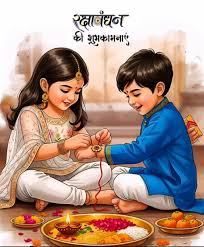
The central ritual of Raksha Bandhan is simple yet profound. A sister ties the rakhi around her brother’s wrist while offering prayers for his health, happiness, and long life. In return, the brother gives gifts and, more importantly, pledges to stand by her and protect her from harm. The rakhi itself is not merely an ornament—it is a raksha sutra, a sacred thread imbued with blessings. Traditionally, it is accompanied by roli (red powder) and akshat (uncooked rice) placed on a ceremonial plate, with the sister applying a tilak to her brother’s forehead before the tying. The simplicity of the ritual belies its depth: it is a consciously enacted moment of care, one that both reaffirms familial ties and reminds us of our responsibilities to each other.
In modern times, Raksha Bandhan has grown even more inclusive. It is now common for cousins, close friends, and even neighbours to participate. Many tie rakhis to soldiers, police officers, or community elders, recognising their role in safeguarding the wider family of society. In schools and workplaces, rakhi-making activities and small ceremonies encourage younger generations to see the festival not just as a gendered or familial event, but as a celebration of trust, gratitude, and mutual respect. The digital era has added its own variations—virtual rakhis, video calls, and couriered threads that carry emotion across continents—ensuring the festival thrives among the global Indian diaspora.
Raksha Bandhan delivers something essential to the human experience that goes beyond its own cultural shape. Festivals like this one provide purposeful interaction to break up the monotony of daily life in an era characterized by speed, isolation, and the breakdown of shared rituals. They serve as a reminder that relationships need intentional care, that caring needs to be communicated, and that reciprocal actions of recognition frequently maintain identity. Festivals provide intimate encounters where modern life encourages anonymity and celebrate interdependence where it promotes self-sufficiency. For this reason, while being centuries old, Raksha Bandhan continues to resonate with our most pressing needs in the twenty-first century.
In addition, the celebration has a philosophical significance that goes well beyond siblinghood. It puts into practice a fundamental tenet of many spiritual traditions: that being able to defend and be defended is a fundamental aspect of our humanity. Tying a protecting thread is a ritual invocation of the divine to observe and sanctify a bond, and it is more than just a symbolic practice in Hinduism. This fact, however, is not unique to any one religion; symbolic actions of blessing, solidarity, and promise have been employed throughout history to unite people and forge circles of belonging that withstand the forces of divide.
It is here that Raksha Bandhan has a special and poignant relevance for Kashmir, a region whose history is marked by a deep and rich tradition of syncretism. Kashmiri culture, shaped over centuries by Hindu, Buddhist, and Islamic influences, has long upheld the idea of spiritual brotherhood—the recognition that beyond creed and bloodline lies a deeper kinship of humanity. The valley’s philosophy of belonging and inclusivity has embodied this vision, where religious festivals are not isolated markers of one community, but shared occasions that affirm the collective spirit. In this context, Raksha Bandhan can be seen not merely as a Hindu festival but as part of the shared cultural heritage of the region. It echoes the ethos that no one is excluded, that bonds of care extend beyond family and faith, and that protection is a mutual duty among all who share a home, a land, and a history.
In Kashmir, as in other parts of India, Raksha Bandhan’s message has the potential to act as a gentle counterpoint to forces that seek to divide. Its very act, of tying a thread without asking who is “us” and who is “them”, is a small but powerful enactment of unity. In villages and towns where neighbours of different religions have lived side by side for generations, such festivals remind people of the bonds that predate modern political fractures. They affirm that one need not share ancestry to share loyalty, that the promise of protection can be given freely and accepted gratefully, and that belonging is as much a choice as an inheritance.
Raksha Bandhan provides a remedy for alienation, which frequently appears in our contemporary society as a feeling of not being fully recognized or appreciated. “You matter to me; I will stand by you” is the ritual’s lasting emotional message, even if it only lasts a few minutes. Such a sentiment starts to weave a web of mutual care and trust when it is extended beyond family to friends, coworkers, neighbors, or even complete strangers in uniform who serve the community. This is the development of social capital, the unsung but vital glue of human existence; it is not just sentimentality.
Ultimately, Raksha Bandhan is not bound to a single definition. It is an inheritance of story and ritual, a moment of personal affection, a public declaration of solidarity, and, when embraced widely, a gentle form of resistance against the forces of isolation and division. It invites us to slow down, to acknowledge one another, to remember that being human is not a solitary condition but a shared journey. The act of tying a rakhi is a little yet significant one, regardless of whether it is celebrated in the privacy of a family room, on a busy street, or throughout Kashmir’s diverse ethnic mosaic. It teaches us that in a world of shattered ties, even a single thread can have immense strength, that protection is precious, and that ties—whether they be ties of kinship, friendship, or shared humanity—are worth re-establishing.
“न त्वेवाहं जातु नासं न त्वं नेमे जनाधिपाः।”
“Never was there a time when I did not exist, nor you, nor all these kings.”
— Bhagavad Gita 2.12
This reflects the eternal bond between souls — like that of a brother and sister, who are spiritually connected across lifetimes.

About the Author